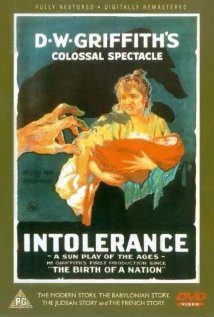

Intolerance (1916) |
|
| Director(s) | D.W. Griffith |
| Producer(s) | D.W. Griffith |
| Top Genres | Drama, Epic, Historical, Romance, Silent Films |
| Top Topics | Prejudice |
Featured Cast of Intolerance See More »

Intolerance
Released
1916
Mae Marsh
(as The Dear One)

Intolerance
Released
1916
Robert Harron
(as The Boy)

Intolerance
Released
1916
Sam De Grasse
(as Arthur Jenkins)
Intolerance
Released
1916
Vera Lewis
(as Mary T. Jenkins)

Intolerance
Released
1916
Mary Alden
(as Self)

Intolerance
Released
1916
Walter Long
(as The Musketeer of the S...)

Intolerance
Released
1916
Monte Blue
(as Strike Leader)

Intolerance
Released
1916
Bessie Love
(as The Bride of Cana)
Intolerance Overview:
Intolerance (1916) was a Drama - Historical Film directed by D.W. Griffith and produced by D.W. Griffith.
SYNOPSIS
Griffith's mammoth achievement, spanning several centuries and cultures. The silent film presents four stories linked solely by a single common thread: intolerance. Three of the stories are based on historical fact: medieval France during the reign of Charles IX; the birth and crucifixion of Christ; and the fall of Babylonia. The fourth tale is a "modern" story of greed, cruelty, and betrayal. Intolerance had its New York premiere on September 5, 1916; it was released two years after The Birth of a Nation, and it is widely regarded as Griffith's protest and self-defense against the charges of racism leveled at him for Birth's glorification of the Ku Klux Klan. Composer Carl Davis created a new score for a recent release.
(Source: available at Amazon AMC Classic Movie Companion).
Intolerance was inducted into the National Film Registry in 1989.
Intolerance BlogHub Articles:
Silents are Golden: A Closer Look at – Intolerance (1916)
Silents are Golden: A Closer Look at: Intolerance (1916) Along with my “Silent Superstars” series, I thought it would be fun to dive into the history behind specific films. Let’s start with a look at one of biggest spectacles ever put on film–Intolerance! It is one of the grandest,... Read full article
Intolerance (1916)
His ambitious follow-up to The Birth of the Nation a year before, D.W. Griffith’s Intolerance boasts four narrative threads meant to intertwine in a story of grand design. Transcending time, eras, and cultures, this monumental undertaking grabs hold of some of the cataclysmic markers of world ... Read full article
Intolerance (1916)
His ambitious follow up to The Birth of the Nation a year before, D.W. Griffith’s Intolerance boasts four narrative threads meant to intertwine in a story of grand design. Transcending time, eras, and cultures, this monumental undertaking grabs hold of some of the cataclysmic markers of world ... Read full article
Intolerance: Love’s Struggle Throughout the Ages (1916)
Intolerance: Love’s Struggle Throughout the Ages Directed by D. W. Griffith 1916/USA Triangle Film Corporation/Wark Producing Repeat viewing #5 of 1001 Movies You Must See Before You Die IMDb users say 7.9; I say 5.0 My definition of a movie I’m glad I don’t have to see again bef... Read full article
Watch: Intolerance: Love’s Struggle Through the Ages (1)
Summer seems to be on hiatus in my backyard this Saturday. If the same is true where you live, then maybe it’s the perfect time to drag your laptop over to the cozy, comfy bed and settle in for a watch of D.W. Griffith’s epic Intolerance: Love’s Struggle Through the Ages. I have so... Read full article
See More Intolerance Articles