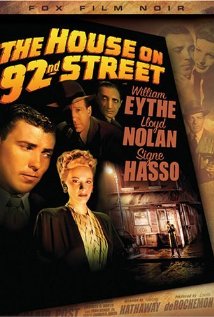

The House on 92nd Street (1945) |
|
| Director(s) | Henry Hathaway |
| Producer(s) | Louis de Rochemont |
| Top Genres | Crime, Drama, Film Noir, Mystery, Thriller/Suspense |
| Top Topics | Spies |
Featured Cast of The House on 92nd Street See More »

The House on 92nd Street
Released
1945
William Eythe
(as Bill Dietrich)

The House on 92nd Street
Released
1945
Lloyd Nolan
(as Agent George A. Briggs)

The House on 92nd Street
Released
1945
Signe Hasso
(as Elsa Gebhardt)
The House on 92nd Street
Released
1945
Gene Lockhart
(as Charles Ogden Roper)

The House on 92nd Street
Released
1945
Leo G. Carroll
(as Col. Hammersohn)
The House on 92nd Street
Released
1945
Harry Bellaver
(as Max Cobura)

The House on 92nd Street
Released
1945
Tom Brown
(as Intern)

The House on 92nd Street
Released
1945
Paul Ford
(as Police Sergeant)
The House on 92nd Street
Released
1945
Vincent Gardenia
(as German Spy Trainee)

The House on 92nd Street
Released
1945
E.G. Marshall
(as Attendant at Morgue)
The House on 92nd Street Overview:
The House on 92nd Street (1945) was a Crime - Drama Film directed by Henry Hathaway and produced by Louis de Rochemont.
Academy Awards 1945 --- Ceremony Number 18 (source: AMPAS)
| Award | Recipient | Result |
| Best Writing | Charles G. Booth | Won |
The House on 92nd Street BlogHub Articles:
The House on 92nd Street (1945)
The House on 92nd Street Directed by Henry Hathaway Written by Barré Lyndon, Charles G. Booth, and John Monks Jr. 1945/USA Twentieth Century Fox Film Corporation First viewing/YouTube Although billed as a film noir in The Film Noir Guide, this is a pretty straight forward police-procedural wit... Read full article
The House on 92nd Street (1945)
The House on 92nd Street is commonly listed as a must-see entry in the film noir canon. I deign it a perfect example of a period piece in that it’s incredibly dated. I understand the intent of the semi-documentary style, but the antiquated newsreel format is enough to put audiences to slee... Read full article
See More The House on 92nd Street Articles