Google Ads
Login | Sign Up

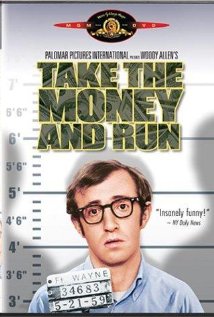
Take the Money and Run Overview:

Take the Money and Run (1969) was a Comedy - Crime Film directed by Woody Allen and produced by Jack Rollins, Edgar J. Scherick, Jack Grossberg, Charles H. Joffe and Sidney Glazier.

Take the Money and Run BlogHub Articles:

Take the Money and Run (1969)

Take the Money and Run Directed by Woody Allen Written by Woody Allen and Mickey Rose 1969/US IMDb link First viewing/Netflix rental Way before he was sophisticated, Woody Allen was ridiculous … and hilarious.  This, his directorial debut, is classic early Allen. The film takes the form of ... Read full article


Take the Money and Run (1969)

... Read full article


Take the Money and Run (1969)

... Read full article


Take the Money and Run (1969, Woody Allen)

Take the Money and Run kind of dangles on a line. It’s occasionally a screwball comedy–something the Marx Brothers would have done–and alternately a thought-out spoof of documentaries. The breeze moves the film’s direction and it’s hard to know where it’ll go next... Read full article


See More Take the Money and Run Articles

Take the Money and Run Quotes:

Virgil: Do you know if it's raining outside?

Bank Teller #1: Does this look like "gub" or "gun"?
Bank Teller #2: Gun. See? But what does "abt" mean?
Virgil: It's "act". A-C-T. Act natural. Please put fifty thousand dollars into this bag and act natural.
Bank Teller #1: Oh, I see. This is a holdup?

Virgil: After fifteen minutes I wanted to marry her, and after half an hour I completely gave up the idea of stealing her purse.

Virgil: Nobody wears beige to a bank robbery!
See More Quotes from Take the Money and Run
Take the Money and Run Facts
Virgil's inept attempt to escape prison by carving a gun out of soap and turning it black with shoe polish is loosely based on real life bank robber John Dillinger's famous escape from the Crown Point, Indiana jail using a wooden gun blackened with shoe polish. In an interesting parallel, in the film Dillinger directed by John Milius and starring Warren Oates as John Dillinger, he is shown using a bar of soap instead of a piece of wood.

One hundred San Quentin prisoners were paid a small fee to work on the film during the prison sequences. The regular cast and crew were stamped each day with a special ink that glowed under ultra-violet light so the guards could tell who was allowed to leave the prison grounds at the end of the day.

Allen initially filmed a downbeat ending in which he was shot to death, courtesy of special effects from A.D. Flowers. Allen's editor, Ralph Rosenblum (whose first work with Allen this was), convinced him to go for a lighter ending.

Allen's first cut was deemed to be decidedly unfunny, including his death scene in a slow-mo hail of bullets, like Bonnie and Clyde. Producers Jack Rollins and Charles H. Joffe convinced him to sit with top editor Ralph Rosenblum to see what could be salvaged. The first thing Rosenblum did was cut out the gory ending, then he restructured the film completely, and generally tightened up Allen's loose narrative. This effort transformed the finished film into a comedy classic. Rosenblum subsequently became Allen's editor of choice on most of his next films, including Bananas, Sleeper, Love and Death and Annie Hall.

Micil Murphy returned to prison for a role in the film. He had become an actor after being paroled from San Quentin in 1966 after serving five and a half years for armed robbery.

See More Facts about Take the Money and Run >>