Home> Facts and Trivia > Stars > Moe Howard
Moe Howard Facts
| Sign | Gemini |
| Born |
Jun 19, 1897 Brooklyn, NY |
| Died |
May 4, 1975 Los Angeles, CA |
| Age | Died at 77 |
| Total Facts | 32 |
(See Ted Healy.)
According to Moe, in sixty years, he never missed a performance.
Brother of actors Curly Howard, Shemp Howard.
Daughter: Joan Howard.
Determined to get into movies, Moe (then going by his middle name, Harry) went to the Brooklyn-based American Vitagraph studios in May, 1909, and volunteered to run errands for the stars and crews without charging for the service. This impressed Maurice Costello, who brought Moe inside and introduced him to the company. Soon, he was appearing in dramas with Costello and comedies with John Bunny and Flora Finch. At first, he didn't tell his family about his movie work. But, when they thought he was losing his mind because he was acting like his characters at home, he told them about his extracurricular activities. Most of his films from this period were lost when the Vitagraph film library burned on 2 July 1910.
Father-in-law of Norman Maurer, with whom he was partnered in Normandie Productions.
Got the idea for the notorious Stooge gag of eye-gouging one day when, during a game of bridge, Shemp Howard leaned over and poked Larry Fine in the eyes for not playing well. The result: Larry cried, Shemp apologized, Moe laughed until he fell out of his chair and walked through a glass door. He considered the eye-gouge the funniest thing he'd ever seen and decided to use it in their act.
Grandfather of Jeffrey Scott and Michael Maurer.
Has two older brothers, Jack Horwitz and Irving Horwitz.
He was very protective of his brother Curly Howard, who was in reality quite shy and not known to stand up for himself.
He, Emil Sitka and Joe DeRita ("Curly Joe") were slated to appear in the R-rated film comedy "The Jet Set" (eventually retitled Blazing Stewardesses (1975)). However, because he was suffering from lung cancer, Moe was forced to drop out of the film. The Ritz Brothers replaced Moe, Sitka and De Rita.
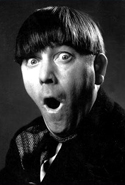
His famous "bowl" haircut came by accident. As a child, his mother always wanted a girl, and with Moe being the youngest at the time, she would play dress-up with him, putting him in dresses and bologna curling his long hair. One day, after being picked on for months in school, he and some friends hid in the shed, and he chopped all of the hair off, using a bowl as a guide. After doing so, he was so afraid to face his mother, he hid for hours. Finally coming out, after seeing his hair, she cried out that she was so happy he did so, simply because she couldn't bring herself to. His hair stuck with him all his life.
His wife, Helen Schonberger, was a cousin of Harry Houdini.
In addition to himself, Moe also supplied the voices for other characters in "The New 3 Stooges" (1965) cartoon series. For example, in "A Flycycle Built for Two" he also was the voice of Orville Wright.
In contrast to his roughneck public persona, Moe was, in private life, a quiet, dedicated family man, whose hobbies included reading, playing bridge and making hooked rugs. The only one of the Stooges who really understood the value of a dollar, investments during his salad days left him a wealthy man at the time of his death.
In the 23 years The Three Stooges worked for Columbia Pictures, they were never completely aware of how popular or how financially successful they were. It was only after the group stopped making shorts that Moe discovered how much more money the act could have earned.
Interred at Hillside Memorial Park, Culver City, California, USA.
Is portrayed by Paul Ben-Victor in The Three Stooges (2000) (TV)
Moe had a legal agreement with his fellow Stooges stating that he reserved the right to choose Stooge replacements (Curly Howard was replaced by Shemp Howard; Shemp was replaced by Joe Besser; Joe was replaced by Joe DeRita).
Moe of The Three Stooges.
Moe was the business-minded one of the group. He knew that Curly liked to spend his money on partying and women, and Larry liked to spend his at the racetrack. So, he drew up an agreement where Larry and Curly turned over a certain percentage of their salaries to him. He, in turn, invested it for them. The result was that, while Larry and Curly were not as wealthy as Moe was (he invested far more of his own money and was quite well off), he ensured that their spendthrift habits did not result in their being broke when their careers ended.
Most of his investments were in real estate.
Right after The Three Stooges' breakup with Ted Healy, Moe signed a contract with Columbia Pictures. Unknown to him, Larry Fine had signed with Carl Laemmle at Universal Pictures. The next morning Moe asked to see Columbia boss Harry Cohn and explained the situation to him. Cohn called up his legal department, which called up Universal's legal department to check the date and time of the contract signing. According to Moe, Cohn hung up the phone and said, "You boys belong to Columbia".
Skinned his nose in a fall down the stairs of his home as a child. His nose was rebuilt by a doctor, but when the doctor turned out to be a phony, he had to have his nose rebuilt all over again by another doctor, whom his mother paid by giving him some of her old copper pots.
Sold frogs in saloons when he was a child to pay for his fares when he skipped school and instead went to the theater.
Son of Sol Horowitz.
Son: Paul Howard.
The Stooges' contract with Columbia gave the studio the right to use their likenesses in perpetuity. This means that no one else can legally use the Stooges' likenesses in any form of media without the studio's permission.
Voice work: for Nintendo Entertainment System (NES) "The Three Stooges" video game (1989).
Was working on his autobiography when he died. Its working title was "I Stooge to Conquer"; it was published posthumously as "Moe Howard and the Three Stooges.".
When The Three Stooges shorts began to appear on local children's shows in the late 1950s, there was a wave of kids poking each other in the eyes. When Moe heard about this, it was the Stooges who came to the rescue. They went on many local television shows, as well as national TV, and showed how the eye-pokes were done in a way that nobody got hurt. To the kids watching, it was like learning a magic trick.
When he and brother Shemp Howard put on shows for families and friends as children, they used younger brother Curly Howard in female roles. Curly, at seven, had trouble remembering his lines so Moe made cue cards on adhesive tape and stuck them to his forehead for Curly to read.