Home> Facts and Trivia > Stars > Gary Cooper
Gary Cooper Facts
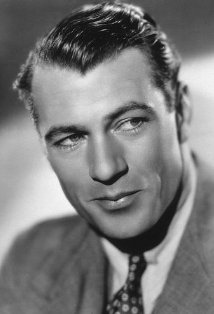
| Sign | Taurus |
| Born |
May 7, 1901 Helena, MT |
| Died |
May 13, 1961 Beverly Hills, Los Angeles |
| Age | Died at 60 |
| Total Facts | 118 |
Marlene Dietrich said about him: "Gary Cooper was neither intelligent nor cultured. Just like the other actors, he was chosen for his physique, which, after all, was more important than an active brain.".
Sam Wood directed him in four movies, The Pride of the Yankees (1942), For Whom the Bell Tolls (1943), Casanova Brown (1944) and Saratoga Trunk (1945).
Frank Capra directed him in two movies, Mr. Deeds Goes to Town (1936) and Meet John Doe (1941).
Howard Hawks directed him in three movies, Today We Live (1933), Ball of Fire (1941) and Sergeant York (1941).
Cecil B. DeMille directed him in The Plainsman (1936), North West Mounted Police (1940), The Story of Dr. Wassell (1944) and Unconquered (1947).
High Time (1960) was originally planned to be a vehicle for Cooper.
Ten North Frederick (1958) was originally intended as a Spencer Tracy vehicle, but Tracy withdrew in poor health.
After James Stewart revealed to the world that Cooper was dying of cancer, messages poured in from such friends and well-wishers as Pope John XXIII, former Vice President Richard Nixon, Henry Fonda, Pablo Picasso, Queen Elizabeth II of England, Princess Grace (Grace Kelly) of Monaco, John Wayne, Ernest Hemingway, former President Dwight D. Eisenhower, Bob Hope, Henry Hathaway, Audrey Hepburn, Mel Ferrer, William Goetz, Mary Livingstone (Mrs. Jack Benny) and Jack Benny, Gloria Stewart (Mrs. James Stewart) and James Stewart, Charles Feldma
After talking with Carl Foreman on the set of High Noon (1952), Cooper realized there had not been an attempt by Communists to infiltrate Hollywood, and later regretted his part in founding the right-wing Motion Picture Alliance for the Preservation of American Ideals.
Along with Sidney Poitier, he is the most represented actor on the American Film Institute's 100 Most Inspiring Movies of All Time, with five of his films on the list. They are: Mr. Deeds Goes to Town (1936) at #83, Sergeant York (1941) at #57, Meet John Doe (1941) at #49, High Noon (1952) at #27 and The Pride of the Yankees (1942) at #22.
Along with actress Mylène Demongeot, Cooper set in motion the first escalator to be installed in a cinema, at the Rex Theatre in Paris on June 7 1957.
Although Cooper dismissed the new school of actors in the 1950s as "a bunch of goof balls" and could be caustic about "the Method" advanced by the Actors Studio in New York, Lee Strasberg told everyone that Cooper was a natural Method actor, he just didn't know it. Cooper did at least admire Marlon Brando's work, and became a producing partner with his father, Marlon Brando Sr..
Although he had said long ago that he would make no more biopics, he signed for The Court-Martial of Billy Mitchell (1955). It was a poor Otto Preminger film and even Mitchell's widow expressed disappointment with Cooper's performance. Possibly the story had appealed to Cooper on political grounds and Mitchell may have been a hero of his - the general who accused the government of neglecting military needs. Cooper went on Ed Sullivan's TV show to promote the film and home viewers were quite disappointed - David Shipman referred to Cooper's "effeminate mannerisms in his TV interviews".
Although he was in failing health, his friend, director Henry Hathaway, had arranged to use him in his segments of How the West Was Won (1962). Upon his death, James Stewart, his best friend, accepted the role.
An uncomfortable aspect of They Came to Cordura (1959) was that besides looking far too old for his character, Cooper was looking so ill, and was actually filming against medical advice. Towards the end of the movie he was dragged a hundred yards along the ground by a railroad handcar, something Stanley Kauffmann complained about in the "New Republic".
Appeared in 107 movies, 82 of which he starred in. Only 16 of those were filmed in color. And he starred in 14 silent movies.
Appeared in eight movies with Walter Brennan. These were Watch Your Wife (1926), The Wedding Night (1935), The Cowboy and the Lady (1938), The Westerner (1940), Meet John Doe (1941), Sergeant York (1941), The Pride of the Yankees (1942) and Task Force (1949).
Appeared in four movies with Fay Wray, The First Kiss (1928), The Legion of the Condemned (1928), The Texan (1930), One Sunday Afternoon (1933).
Appeared in three movies with Barbara Stanwyck, Ball of Fire (1941), Meet John Doe (1941) and Blowing Wild (1953).
Appeared in two movies with Marlene Dietrich, Morocco (1930) and Desire (1936).
Appeared on the cover of Life magazine November 24, 1941.
At first Cooper didn't want to make Friendly Persuasion (1956), not just because he felt the audience wouldn't accept him as a devout Quaker, but also because he did not want to play a father figure. This was despite the fact that he was now 55. On the set he arranged for his daughter Maria Cooper to date Anthony Perkins, not seeming to realize that the young actor was gay.
At the time of his terminal cancer being diagnosed towards the end of 1960, Cooper had signed to star in The Sundowners (1960) and Ride the High Country (1962).
Before his cancer was found to be terminal, he had intended to play James Stewart's role in How the West Was Won (1962).
Born Frank Cooper, he changed his first name to Gary at the suggestion of his agent, Nan Collins, whose hometown was Gary, Indiana.
Both of his parents were immigrants to America from England.
By 1942 he left Samuel Goldwyn and Paramount, then formed his own production company, then on October 22, 1947 he signed with Warner Brothers to make $295,000 per picture.
By June 1955 he had made 80 films from which the studio's earned $250 million and he only earned $6 million in salary and percentages.
Despite his wholesome screen image, he was an infamous (and privately boastful) lady-killer in reality, allegedly having had affairs with numerous and sometimes very famous leading ladies throughout his career. This was in spite of the fact that he had a faithful wife, Sandra, and that many of his lovers were also married.
During the 1944 presidential election the phrase, "I've been for Roosevelt before ... but not this time!" was personally attributed to Cooper, forming the basis of full-page advertisements in major newspapers, paid for by the Republican National Committee. Cooper was extremely active on behalf of the Republican candidate, New York's governor Thomas E. Dewey. He gave speeches, did entertaining for fund raisers, met with Dewey in Los Angeles, and did some personal campaigning in the film community. Whether Cooper had ever been "for Roosevelt before" is questionable. Possibly he voted for him in 1936 during the second term landslide. If so, it was not publicly disclosed. Cooper's activities were as unpopular as Democrat Humphrey Bogart's endorsement of Franklin D. Roosevelt that year. The studio called in both stars and told them to stop antagonizing fans who did not share their political beliefs.
Father of Maria Cooper.
Father-in-law of pianist and composer Byron Janis.
Has played six real life characters on screen. Wild Bill Hickok, Marco Polo, Sgt. Alvin C. York, Lou Gehrig, Dr. Corydon M. Wassell and Gen. Billy Mitchell.
Has starred in a total number of 20 westerns, 3 of those were silent.
He blew the harmonica and strummed the guitar; played backgammon and bridge; grew corn and avocados on the Encino ranch he bought in the early 1930s and loved to work with his tractor in the garden.
He considered himself to be miscast in Peter Ibbetson (1935), The Adventures of Marco Polo (1938), Saratoga Trunk (1945) and Ten North Frederick (1958).
He declined roles in The Big Trail (1930), Stagecoach (1939) and Red River (1948). All of these were subsequently played by John Wayne.
He formed his own production company, Baroda Productions, in 1958. In 1959 the company made three of his more unusual films: The Hanging Tree (1959), They Came to Cordura (1959) and The Wreck of the Mary Deare (1959).
He is the step-uncle of Brooke Shields. Her grandfather is Cooper's wife's step-father, Paul Shields.
He left America and Hollywood and didn't return for 18 months. During that time he was in Hawaii, Mexico and France and shot four films: Return to Paradise (1953), Blowing Wild (1953), Garden of Evil (1954) and Vera Cruz (1954).
He liked sports and kept in shape with hiking and riding, tennis and golf, archery and skiing, trout fishing and spear fishing, swimming and scuba diving and driving fast cars. He liked boxing.
He signed a six year contract with Samuel Goldwyn, to make six pictures at $150,000 per picture. At the time Paramount had legal rights to Cooper and threatened to sue. The two companies came to an understanding that Paramount would loan Cooper to Goldywn to make one picture a year from 1938-1942.
He starred in two movies that were based on novels by Ernest Hemingway: A Farewell to Arms (1932) and For Whom the Bell Tolls (1943).
He turned down both Stagecoach (1939) and Gone with the Wind (1939).
He underwent four hernia operations between 1951 and 1953.
He was a close friend and admirer of Pablo Picasso.
He was a close friend of Bing Crosby, who named his eldest son after Cooper.
He was a conservative Republican. He voted for Calvin Coolidge in 1924, and for Herbert Hoover in 1928 and 1932. He actively campaigned for Wendell Willkie in 1940, strongly believing that Franklin D. Roosevelt should serve no more than two terms of office, and endorsed Thomas E. Dewey in 1944.
He was fond of dogs, at various times he owned boxers, Dobermans and Great Danes. He and his wife also raised Sealyhams.
He was in a car accident as a teenager that caused him to walk with a limp the rest of his life.