Facts > Films > West Side Story
West Side Story (1961) Facts
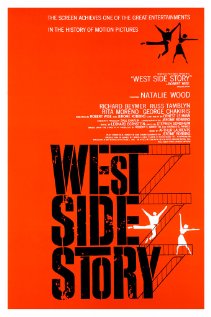
| Director(s) | Jerome Robbins, Robert Wise |
| Producer(s) | Robert Wise, Walter Mirisch (uncredited), Saul Chaplin |
| Featured Cast | Natalie Wood, Richard Beymer, Russ Tamblyn, Rita Moreno, George Chakiris |
| Total Facts | 65 |
"Cool" was such a demanding number for the performers, Harvey Evans (aka Harvey Hohnecker), who played Mouthpiece, later stated that the actors ritually burned their kneepads upon wrapping the scene.
"West Side Story" played for almost two years on stage in New York, racking up a total of 732 performances.
Audrey Hepburn was offered the role of Maria, but she turned it down, because she was pregnant with Sean H. Ferrer at the time.
Robert Wise wanted the film to have a single rising line of tension, with no light moments after the rumble. Therefore, "I Feel Pretty" was moved earlier, and the positions of "Cool" and "Gee, Officer Krupke" were reversed. Those who feel that the sassy, light-hearted tone of "Gee, Officer Krupke" is out of place following the deaths that end the first act prefer the film's ordering of the numbers. The placement of "I Feel Pretty" and "Gee, Officer Krumpke" after the Rumble in the stage version was meant to help cheer people up after the deaths of Bernardo and Riff, as audiences were not used to death occurring in Broadway musicals. This issue is still heatedly debated among the film's fans.
Robert Wise's original choice to play Tony was Elvis Presley.
Jerome Robbins completed four numbers - the Prologue, "Cool", "I Feel Pretty" and "America" - before he was removed from the project.
Jerome Robbins initially refused to work on the film unless he could direct it. Producer Walter Mirisch was nervous about handing the reins entirely over to Robbins, who had never made a film before, so he enlisted Robert Wise to direct the drama while Robbins would handle the singing and dancing sequences. Robbins developed a habit of shooting numerous takes of each scene, to the point where the film went over budget and behind schedule. This led to his firing.
Jerome Robbins rehearsed with the dancers for three months before shooting began. Once location shooting began, however, he kept revising and revising his original choreography. The dancers all claimed that they had never worked so hard on a dance piece, and most of them at one point or another sustained injuries during shooting.
Jerome Robbins' propensity for filming and re-filming scenes in his quest for perfection led to the movie going over budget and falling behind schedule. Robbins was fired by Mirisch Pictures, the production company, when shooting was about 60% finished, and director Robert Wise completed the filming alone (the original arrangement had been for Robbins to direct all of the song-and-dance sequences and Wise to direct everything else).
Marni Nixon (who dubbed for Natalie Wood) had to do the end of quintet for Rita Moreno. The reason was that Betty Wand and Moreno both had colds and could not sing, so the filmmakers asked Nixon to do the end. So she is singing two voices at once.
Eliot Feld (Baby John) collapsed and ended up hospitalized with pneumonia during the demanding filming of "Cool".
Chita Rivera originated the role of Anita when West Side Story premiered at New York's Winter Garden Theatre (September 26, 1957). Rita Moreno later played Anita in the film adaptation of the show.
Gus Trikonis who played Indio, one of the Puerto Rican Sharks - and who is actually Greek - is the brother of Gina Trikonis, who played Graziella, the tough red-haired Italian girlfriend of Riff, leader of the Jets.
Natalie Wood's singing was dubbed by Marni Nixon.
Richard Beymer's singing voice was dubbed by Jimmy Bryant.
Russ Tamblyn (Riff) was dubbed for "The Jet Song" by Tucker Smith, who played Ice, his lieutenant in the movie.
Russ Tamblyn had originally tried out for the role of Tony. It was down to just him and Richard Beymer, and Beymer ended up getting it. But then the casting directors called him back and asked him to read for Riff, and he got the part.
Rita Moreno's singing voice was dubbed by Betty Wand only for "A Boy Like That" since it was below her range. Moreno sang "America" and "Quintet" herself.
George Chakiris (Bernardo) had previously played "Riff" in the London production. Tony Mordente (Action) had played "A-rab."
Betty Wand sued to get a percentage of the movie-album sales, having dubbed part of Rita Moreno's singing. The dispute was settled out-of-court.
Lee Theodore, who played Anybodys in the original Broadway production, served as an assistant choreographer for the film. Russ Tamblyn reports that he and most of the rest of the dancers in the film suffered from shin splints at one time or another, the result of extended dancing on pavement as opposed to a wooden stage or soundstage floor.
A major controversy developed because Carol Lawrence, who played Maria in the stage version, was passed over for the role in favor of Natalie Wood.
Along with all the other songs that were re-written for the movie perhaps one of the songs that was most worked over was "The Rumble Song" (Sometimes known simply as Quintet). Due to the outcome of the war council the best man from each gang will fight it out fairly. The duel in the stage show is initially meant to be fought between Bernardo and Diesel. Diesel didn't appear in this so the duel is between Ice and Bernardo. Also there is a part when Riff is talking Tony into arriving at the Rumble (I'm counting on you to be there tonight/When Diesel wins it fair and square tonight) which changed (We'll be a-backing you boy/You're gonna flatten him good) due to the change of the fighters.
Although the producers tried to keep the different gangs separate during filming to create tension, Russ Tamblyn (Riff) said that he knew of at least one "Jet" who was roommates with a "Shark" through filming.
At the time, this became the biggest selling soundtrack album.
Borrowed its plot from William Shakespeare's "Romeo and Juliet".
Director Robert Wise hired New York gang members to control crowds on location, and fought to shoot on location in New York City.
During the entire production, the actors wore out 200 pairs of shoes, applied more than 100lbs of make-up, split 27 pairs of pants and performed in 30 different recording sessions.
Even though dubbing Natalie Wood was Marni Nixon's chief assignment, Nixon also did one number for Rita Moreno, which required a relatively high vocal register. Having dubbed Wood as well as Moreno, Nixon felt she deserved a cut of the movie-album royalties. Neither the movie or the record producers would bow to her demands. Leonard Bernstein broke the stalemate by volunteering a percentage of his income, a gesture of loyalty-royalty since Nixon had been a performer-colleague of his at New York Philharmonic concerts. He ceded one-quarter of one percent of his royalties to her (a generous amount).
Film rights to the play were bought for $375,000.
Filmed on-location on West 61st Street.
In 1962, the Columbia Records soundtrack release commanded the number-one spot on the "Billboard" popular albums chart from May 5 through June 16, and again from October 6 through October 13.
In 1998, the American Film Institute ranked this as the #41 Greatest Movie of All Time. It fell to #51 in the updated list released in 2007.
In 2010, Stephen Sondheim (who wrote the lyrics) told "Fresh Air" interviewer Terry Gross that while he was writing the stage musical, he originally wanted the show to be the first one in Broadway history to use the words "fuck" and "shit" in its song lyrics. He wanted the end of the song "Gee, Officer Krupke" to be "Gee, Officer Krupke/Fuck you!" (instead of what it became, which is "Gee, Officer Krupke/Krup you!"), and he wanted the lyrics in "The Jets Song" to be "When you're a Jet/If the shit hits the fan" instead of "When you're a Jet/If the spit hits the fan". However, the show's writers were informed that if the Original Cast Album contained those profanities, it would have been illegal to ship the record across state lines. So Sondheim made the substitutions for those words that appear in both the stage show and the movie.
In a few scenes, a poster can be seen for Palisades Park, which was a real amusement park which operated in Cliffside Park (or Fort Lee), New Jersey from 1898 to 1971.
In the scene on the roof before the musical number "America", when the girls are mocking Bernardo's speech, one of the girls say ,"We came with our hearts open", one of the Sharks says, "You came with your pants open!" This line had to be changed to "You came with your mouth open," for the movie because of censorship standards.
Many shots imitate the work of modern American painters of New York City, especially the work of Ben Shahn and Robert Vickery.
Most of the original Broadway cast were rejected for the film as either photographing too old or actually being too old for the teenaged characters. Since Hollywood was accustomed to dubbing the singing voices of many stars, dozens of non-singing actors and actresses were tested or considered for the leading roles. Among them: Suzanne Pleshette, Jill St. John, Audrey Hepburn, Anna Maria Alberghetti, Elizabeth Ashley, Anthony Perkins, Warren Beatty, Bobby Darin, Burt Reynolds, Richard Chamberlain, Troy Donahue and Gary Lockwood.
Opening dance sequences were shot on the upper west side of Manhattan where Lincoln Center stands today. This area was condemned and the buildings were in the process of being demolished to make way for Lincoln Center. The demolition of these buildings was delayed so that the filming of these sequences could be completed.
Original plans for the play to involve a Jewish boy and an Irish Catholic girl were abandoned because producer Arthur Laurents felt it too closely mirrored the play "Abie's Irish Rose".
Riff and Tony repeat an oath of loyalty to each other: Riff says "womb to tomb" and Tony answers "birth to earth." On stage Tony's original answer was "sperm to worm," but this was changed for the movie because it was beyond the censorship standards of the time.
Shooting in 65mm was prohibitively expensive. After their experiences making this film - and especially Jerome Robbins' extensive reshooting - the Mirisch brothers refused to make any more films in the format.
Shooting lasted for 6 months, sound mixing and editing for 7.
Six members of the original Broadway cast appeared in the movie: Carole D'Andrea (Velma), David Winters (movie: A-Rab, Broadway: Baby John), Jay Norman (movie: Pepe, Broadway: Juano), Tommy Abbott (Gee-Tar), Tony Mordente (movie: Action, Broadway: A-Rab), William Bramley (Officer Krupke).
The "America" sequence on stage was conceived as a duet between Anita and Rosalia. For the film, it was altered to be one between Anita and Bernardo.
The actors in the rival gangs were instructed to play pranks on each other off the set to keep tensions high.
The Al Wood posters are in reference to Allen K. Wood, who was one of the production designers.
The boys' jeans were dyed, re-dyed and "distressed," using special elastic thread to allow for the severity of the choreography.
The film ran in Paris for a grand total of 249 weeks, making it the longest running film in French history.
The interior sets were built six feet off the ground to allow for low-angle shooting with large 70mm cameras.