Facts > Films > West Side Story
West Side Story (1961) Facts
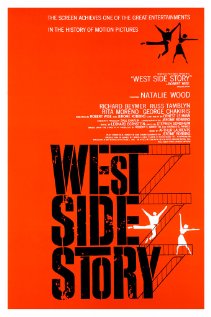
| Director(s) | Jerome Robbins, Robert Wise |
| Producer(s) | Robert Wise, Walter Mirisch (uncredited), Saul Chaplin |
| Featured Cast | Natalie Wood, Richard Beymer, Russ Tamblyn, Rita Moreno, George Chakiris |
| Total Facts | 65 |
The lyrics to "America" were substantially changed for the movie. There had been complaints that the Broadway version was too belittling to Puerto Ricans, in that the song mainly ridiculed Puerto Rico and Puerto Ricans. The movie lyrics emphasize the racism and discrimination that Puerto Ricans were subjected to in America.
The original Broadway production of "West Side Story" opened at the Winter Garden Theater on September 26, 1957, ran for 732 performances and was nominated for the 1958 Tony Award for the Best Musical.
The original stage version of Maria's song "I Feel Pretty" included the lyrics "I feel pretty and witty and bright / And I pity / Any girl who isn't me tonight." In the film this night scene was changed to the daytime, and presumably for this reason, the rhyming words "bright" and "tonight" were changed to "gay" and "today."
The second highest grossing film of 1961, coming in just behind One Hundred and One Dalmatians.
The ship seen in the opening aerial view of the city is the SS United States of the United States Lines. It first sailed in 1952 and was laid up in the late 1960's and has been idle ever since. It was recently bought by NCL to be refurbished as a cruise ship. The SS United States currently sits rusting away at a pier on the Delaware River in Philadelphia. PA.
The song "Gee Officer Krupke" was banned by the BBC because of its mentions of drug use and sexual ambiguity.
The song "One Hand, One Heart" was written for the earlier musical "Candide," but later discarded by Leonard Bernstein and revived for "West Side Story."
The songs "I Feel Pretty", "Gee Officer Krupke" and "Cool" were moved for the movie. The first two originally followed the Rumble, and "Cool" was performed outside Doc's Candy Store. It was felt that the message of "Cool" was more appropriate for how the Jets would handle being approached by the police. The light tone of "I Feel Pretty" was felt wrong for the mood of the piece after the Rumble, so it was moved to the start of the second act.
The stage lyrics for the song "Gee, Officer Krupke" are "My father is a bastard, my ma's an s.o.b. My grandpa's always plastered..." The lyrics had to be changed for the movie to: "My daddy beats my mommy, my mommy clobbers me, my grandpa is a commie..." Also, the stage lyric was, "Dear kindly social worker, they say go earn a buck, like be a soda jerker, which means like be a schmuck." For the film, the lines were changed to "Dear kindly social worker, they say go get a job, like be a soda jerker, which means I'd be a slob."
The stage version was originally planned as a story about a Catholic boy falling in love with a Jewish girl. The working title was "East Side Story". After a boom of Puerto Rican immigration to New York in the late 1940s and 1950s, the story was changed, and the show opened on Broadway in 1957 as "West Side Story".
Throughout the movie, Natalie Wood wears a bracelet on her left wrist, not for any aesthetic reason, but because she had injured her wrist on in the scene of The Green Promise when she fell on the bridge that collapsed during the severe rainstorm, causing an unsightly bone protrusion on her wrist. She wore the bracelet to hide the injury. It became her trademark in all of her movies.
Was the first film to win a Best Director Oscar for two directors (Robert Wise and Jerome Robbins). This would not happen again until 46 years later, when Joel Coen and Ethan Coen shared the award for No Country for Old Men.
When filming "The Taunting Scene", Rita Moreno was reduced to tears when she was harassed and nearly raped by the Jets, as it brought back memories of when she was raped as a child. When she started crying, the Jets immediately stopped what they were doing and tried to comfort her, while pointing out that the audience was going to hate them for what they were doing.
When the musical premiered in Europe in 1958, it was staged at the Manchester Opera House (UK).
With its win of 10 Academy Awards, this became the biggest Oscar-winning musical of all time, beating the record Gigi set three years before with its nine Oscars.