Facts > Films > The Longest Day
The Longest Day (1962) Facts
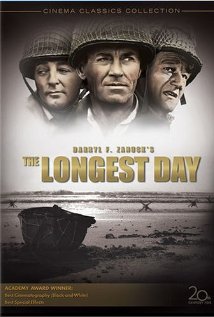
| Director(s) | Ken Annakin, Andrew Marton, Bernhard Wicki, Darryl F. Zanuck (uncredited) |
| Producer(s) | Darryl F. Zanuck, Elmo Williams |
| Featured Cast | Eddie Albert, Paul Anka, Richard Beymer, Richard Burton, Red Buttons |
| Total Facts | 77 |
Sean Connery asked that his scenes be filmed quickly so he could get to Jamaica in time to star in Dr. No.
Sean Connery, who made his debut as James Bond also in 1962, acted in the movie along with Gert Fröbe and Curd Jürgens - two future Bond villains.
John Robinson, who plays Admiral Ramsay, actually took part in the D-Day landings.
Donald Houston who plays the one scene RAF Pilot actually was in the RAF during the Second World War.
Darryl F. Zanuck and Cornelius Ryan collaborated on the screenplay but they immediately hated each other upon their first meeting. It was up to producer Elmo Williams to liaise between the two and keep the peace.
Darryl F. Zanuck was continually at Andrew Marton's shoulder when he was directing the American sequences.
Darryl F. Zanuck was quoted in an interview as saying that he didn't think much of actors forming their own production companies, citing The Alamo, produced by John Wayne, as a failure of such ventures. Wayne found out about this interview before being approached by Zanuck, and refused to appear in the film unless he was paid $250,000 for his role (when the other famous actors were being paid $25,000). Wayne got his requested salary.
Alec Guinness was sought for a cameo.
Dewey Martin filmed scenes playing the cameo role of Lt.Wilder, but his scenes were deleted in post-production.
Richard Todd (playing Major John Howard, Officer Commanding D Company of The 2nd Battalion The Oxfordshire and Buckinghamshire Light Infantry, Air Landing Brigade, 6th Airborne Division) was himself in Normandy on D-Day, and participated as Capt. Todd of the 7th Parachute Battalion, 5th Parachute Brigade, British 6th Airborne Division. His battalion actually went into action as reinforcements, via a parachute jump (after the gliders had landed and completed the initial coup de main assault). Capt. Richard 'Sweeney' Todd was moved from the plane he was originally scheduled to jump from, to another. The original plane was shot down, killing everyone on board.
Richard Todd, veteran of the action at the bridge at Benouville (later renamed Pegasus Bridge) (see Item 1 above), was offered the chance to play himself but joked, "I don't think at this stage of my acting career I could accept a part 'that' small." He played the commander of the actual bridge assault itself, Major John Howard, instead.
Curd Jürgens plays General Blumentritt. In real life, Jurgens had actually been imprisoned by the Nazis.
Kenneth More, playing Capt. Colin Maud, carried the shillelagh Maud had used in the actual invasion. Maud loaned it to More so the actor could use it in the film.
Richard Dawson's film debut.
Leslie Phillips only has one line in this movie.
Eddie Albert, who played Colonel Thompson, was a World War II veteran. However, Albert actually served in the Pacific, not in Europe.
Red Buttons was cast in the film after he ran into Darryl F. Zanuck in a Paris cafe.
Russell Waters is credited by various who's who's as being in the film, but he is nowhere to be seen.
Henry Grace was not an actor when being cast as Dwight D. Eisenhower, but his remarkable resemblance to Eisenhower got him the role.
20th Century Fox were taking a real gamble making this film. At $10 million, it was a hugely daring venture, but even more risky was Cleopatra which was being filmed concurrently. This was to set Fox back the then unprecedented sum of $40 million. Although Cleopatra did well at the box office, it was simply too expensive to recoup its costs and nearly bankrupted the studio. Fortunately The Longest Day turned out to be one of their biggest hits to offset the damage caused by the Egyptian epic.
A colorized version of this film was released on VHS in 1994, the fiftieth anniversary of the invasion.
A number of sources credit Christopher Lee and Geoffrey Bayldon as being in this project but Lee denies working on the film and Bayldon is nowhere to be seen in the final print.
According to fellow veterans major Werner Pluskat was not at his command bunker in Omaha Beach when the first wave of the invasion forces landed, instead he was in a bordello in Caen.
Adolf Hitler doesn't make an appearance in the film. In reality, he slept through the start of the D-Day landings, having taken a sleeping pill.
Alongside the three credited directors, Gerd Oswald directed the parachute drop scene and Darryl F. Zanuck himself did some pick-ups.
Although the screenplay is credited to Cornelius Ryan, many other writers worked on the film.
An estimated 23,000 troops were supplied by the U.S., Britain and France for the filming. (Germans only appeared as officers in speaking roles.) The French contributed 1,000 commandos despite their involvement in the Algerian War at the time.
As a 22-year-old private, Joseph Lowe landed on Omaha Beach on D-Day with the Second Ranger Battalion and scaled the cliffs at Point-Du-Hoc. He scaled those hundred-foot cliffs all over again, for the cameras, some 17 years later.
As part of John Wayne's contract, in addition to his high fee, he demanded he received separate billing. Usually in film credit this would mean them starting off with "Starring John Wayne and.... the other actors" however the credits begin with "starring *the other actors*... and John Wayne" Wayne's name appears last on the credits, while still meeting the separate billing clause of his contract. Many of the other cast (who had actually taken part in D-Day and WW2) held Wayne's refusal to join up during the war with some disdain.
As there was a nudist colony two miles inland from the Corsican beach, it was necessary to post signs warning the colonists not to approach the water during filming.
As would be done again later in the WWII epic, Patton, the Twentieth-Century Fox logo is never shown onscreen in this film.
Average Shot Length = ~8 seconds. Median Shot Length = ~6.5 seconds
Colonel Benjamin Vandervoort was very disappointed to find that he was being played in the movie by John Wayne, since even 17 years after D-Day Vandervoort was still a decade younger than the 54-year-old Wayne.
Despite being in two scenes Gert Fröbe never actually says a word.
Despite being one of the more lengthy cameos it only took four days to shoot John Wayne's major cameo.
Despite the Cornelius Ryan connection, the only stars to appear in both this film and A Bridge Too Far are Sean Connery and Wolfgang Preiss.
Due to the massive cost overruns on the film Cleopatra (which was filming contemporaneously), Darryl F. Zanuck had to agree to a fixed filming budget. After he had spent the budgeted amount he started using his own money to pay for the production.
During shooting in Ste. Mère-Eglise, traffic was stopped, stores were closed and the power was shut down in order not to endanger the paratroopers who were unused to night drops in populated areas. Still, the lights and staged fire proved too difficult to work around, and only one or two jumpers managed to land in the square - with several suffering minor injuries. One of the initial jumpers broke both legs in landing. Ultimately, plans to use authentic jumps were abandoned, opting instead for rigged jumps from high cranes.
During the filming of the landings at Omaha Beach, the American soldiers appearing as extras didn't want to jump off the landing craft into the water because they thought it would be too cold. Robert Mitchum, who played General Norm Cota, finally got disgusted with them and jumped in first, at which point the soldiers had no choice but to follow his example.
During the making of the film, Darryl F. Zanuck effectively commanded more "troops" than any of the generals during the actual campaign.
Field Marshal Erwin Rommel's (Werner Hinz) son, Manfred Rommel is played by Michael Hinz, the real life son of Werner Hinz.
First film of Siân Phillips.
Former U.S. President Dwight D. Eisenhower was considered for the role of himself in the film, and he indicated his willingness. However, it was decided that makeup artists couldn't make him appear young enough to play his WWII self.
Four Spitfires were used in the strafing sequence. They were all ex-Belgian target tugs and all were MK9's. The serial no.s were MH415, MK297, MK923 and MH434 and all are still extant. The Spitfires were assembled and co-ordinated by former free French Spitfire pilot Pierre Laureys who flew with 340 Squadron, a free French unit in the RAF. The 4 Spitfires were of course re-painted in 340 Squadron markings. Spitfire MK923 was between 1963 and 1998 owned by film actor and Oscar winner Cliff Robertson.
In 1963, Black civil rights organization the NAACP accused Hollywood studios of racial discrimination. Using 'The Longest Day' as an example, it said that there were some 1,700 black soldiers who took part in the actual landings, but this movie featured not a single black actor.
In his memoirs Christopher Lee recalls being rejected for a role in the movie because he didn't look like a military man (he served in the RAF during WW2).
In Italy for the filming of Cleopatra, Roddy McDowall became so frustrated with the numerous delays during its production, he begged Darryl F. Zanuck for a part in this picture just so he could do some work. He ended up with a small role as an American soldier.
In researching his contribution to the script, Romain Gary uncovered one of Cornelius Ryan's mistakes: the casino at Ouistreham had not existed on June 6, 1944. Since the casino set had already been built, however, the scene taking place there was filmed anyway.
In the Spanish version, actors Fernando Rey and Jesús Puente dubbed actors Henry Fonda and Peter Lawford.
Just before shooting began in Corsica, Darryl F. Zanuck was approached by a man stating he represented the beach owners. He insisted on a $15,000 payment or else they would drive modern cars along the beach. Zanuck paid the money, but it was later discovered to be a scam as there were no private beaches in Corsica. Zanuck eventually won damages after an eight-year lawsuit.