Facts > Films > The Longest Day
The Longest Day (1962) Facts
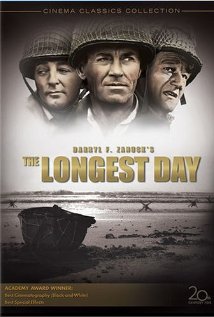
| Director(s) | Ken Annakin, Andrew Marton, Bernhard Wicki, Darryl F. Zanuck (uncredited) |
| Producer(s) | Darryl F. Zanuck, Elmo Williams |
| Featured Cast | Eddie Albert, Paul Anka, Richard Beymer, Richard Burton, Red Buttons |
| Total Facts | 77 |
Many of the beach scenes were filmed in Corsica.
Many of the military consultants and advisers - drawn from both sides - were actual participants on D-Day itself.
No gliders of the sort used in the invasion were available, so Darryl F. Zanuck commissioned new duplicates from the same company that built the originals.
One of producer Darryl F. Zanuck's big worries was that, as filming of the actual invasion drew near, he couldn't find any working German Messerschmitts, which strafed the beach, or British Spitfires, which chased them away. He finally found two Messerschmitts that were being used by the Spanish Air Force, and two Spitfires that were still on active duty with the Belgian Air Force, and rented all four of them for the invasion scenes.
One of the uncredited writers on the film was James Jones, author of "From Here to Eternity".
One of the very first World War II films made by an American studio in which the members of each country spoke nearly all their dialog in the language of that country: the Germans spoke German, the French spoke French, and the Americans and the British spoke English. There were subtitles on the bottom of the screen to translate the various languages. There were two versions of this movie, one where all the actors spoke English and the other(the better known one) where the French and German actors spoke their respective languages.
Only 6% of the paratroopers depicted actually achieved their goal. 60% of the men and equipment parachuted in on D-Day was lost.
Producer Darryl F. Zanuck paid the original author Cornelius Ryan $175,000 for the screen rights to his book.
Pundits nicknamed the film "Z-Day".
The biggest grossing black and white film up until the advent of Schindler's List.
The cameo part of the British Padre was first offered to Dirk Bogarde.
The character who calls the homing pigeons on Juno beach "Traitors" when they appear to fly east towards Germany is Canadian journalist Charles Lynch, who landed with the Canadians and covered the landings for Reuters.
The fleet scenes were filmed using 22 ships of the U.S. Sixth Fleet during maneuvers off Corsica between June 21-30, 1961. The cameras had to avoid shooting the area where the fleet's aircraft carrier was positioned, as there were no carriers in the invasion.
The French Resistance woman shown at the start of the film is played by Irina Demick, who was Darryl F. Zanuck's girlfriend at the time.
The Germans were deliberately not portrayed in stereotypical style. The words "Sieg Heil", for instance, are never said, although they can be seen written on a bunker wall in Ouistreham.
The Messerschmitts used to portray Luftwaffe fighters were not Bf-109s, but were actually Bf-108 Taifuns, a four-seat cabin monoplane design with a wider fuselage.
The piper who played the bagpipes as Lord Lovat's commandos stormed ashore is played by the late Pipe Major Leslie de Laspee who was at the time Pipe Major of the London Scottish Pipe Band, and personal piper to HM the Queen Mother. The actual man who did this stirring deed on D-Day is Bill Millin. He recently donated that very set of pipes to the national war memorial in Edinburgh Castle.
The production had 36 real landing craft and 2 real German planes at its disposal.
The role of Lieutenant Colonel Benjamin Vandervoort was actively sought by Charlton Heston, but the last-minute decision of John Wayne to take a role in the film prevented Heston from participating.
The Spitfire planes needed to be fitted with new Rolls-Royce engines before being usable.
The theme song to the movie, by Paul Anka, was used as the Regimental march of the Canadian Airborne Regiment (1968-1995)
The two German "Messerschmitt 109 fighters" attacking the beach were actually four-seat Messerschmitt 108 liaison planes. In real life, Priller and Wodarcyk flew Focke Wulf 190's. Both survived.
There was some controversy over the casting. At 54, John Wayne was 27 years older than Colonel Vandervoort had been at the time of D-Day. At 52, Robert Ryan was fifteen years older than General Gavin had been.
To create a more sympathetic stance to each of the different parties, Darryl F. Zanuck had Englishman Ken Annakin direct the British segments, the American parts were handled by Yank Andrew Marton, while German Bernhard Wicki took care of the scenes with the German army officers.
When cost overruns on Cleopatra threatened to force 20th Century Fox to shut down production of this film, Darryl F. Zanuck flew to New York to save his project. After an impassioned speech to Fox's board, Zanuck regained control of the company he founded, ultimately finishing this picture and getting the production of Cleopatra under control.
While clearing a section of the Normandy beach near Ponte du Hoc, the film's crew unearthed a tank that had been buried in the sand since the original invasion. Mechanics cleaned it off, fixed it up and it was used in the film as part of the British tank regiment.
With a $10,000,000 budget, this was the most expensive black & white film ever made until Schindler's List.