Hamlet (1948) Facts
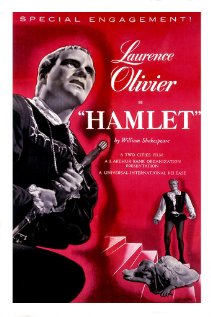
| Director(s) | Laurence Olivier |
| Producer(s) | Anthony Bushell, Herbert Smith (uncredited), Reginald Beck |
| Featured Cast | Laurence Olivier, Jean Simmons, John Laurie, Niall MacGinnis, Harcourt Williams |
| Total Facts | 24 |
Laurence Olivier played the voice of Hamlet's father's ghost himself by recording the dialog and playing it back at a reduced speed, giving it a macabre quality. The role is often erroneously reported as being performed by Sir John Gielgud, perhaps because it does sound vaguely like him, but it has been said that Olivier actually disliked working with Gielgud in William Shakespeare films, and turned down his request to play the Chorus in The Chronicle History of King Henry the Fift with His Battell Fought at Agincourt in France. If Gielgud had played the Ghost in Hamlet, it would have been the first of three appearances (so to speak) as the character: Gielgud played the Ghost in Hamlet and Hamlet.
Laurence Olivier was 41 when Hamlet was released. Eileen Herlie, who played Hamlet's mother Gertrude, was 28.
Stanley Holloway was an 11th-hour choice; the actor who was supposed to play the grave digger, F.J. McCormick, died shortly before filming.
Claire Bloom auditioned for the role of Ophelia.
Desmond Dickinson had a very maneuverable camera dolly specially made for this film with Pneumatic tires. It was the first of its kind in England.
According to a book written in 1948, many actresses refused the role of Hamlet's mother because of age concerns.
As of 2010, Christopher Lee and Patrick Macnee are the only surviving cast members of the film.
At $2 million, this was a very expensive production in its day.
Because they wanted to aim at a wider public in Hamlet than they had in The Chronicle History of King Henry the Fift with His Battell Fought at Agincourt in France, Sir Laurence Olivier and text adaptor Alan Dent modernized and/or clarified several obscure phrases in the play: "The cock, that is the trumpet to the morn" became "The cock, that is the herald to the morn", "recks not his own rede" became "minds not his own creed", "In the same figure, like the King that's dead" became "in the same figure, like the dead King Hamlet", and "It may be, very like" became "It may be, very likely", among others.
First full length feature film of Terence Morgan.
Fortinbras, Prince of Norway, a minor character in the play, does not appear in the film. Some of his lines are given to Horatio.
Greatly influenced by the inventive camera effects that Orson Welles and Gregg Toland pioneered in Citizen Kane, and by the psychological reinterpretations of the play that were being floated at the time.
Initially, Laurence Olivier was not keen on producing "Hamlet". Although he wanted to repeat the success of The Chronicle History of King Henry the Fift with His Battell Fought at Agincourt in France, he found that the Danish play was the only really viable choice, as Orson Welles had just done Macbeth and was prepping The Tragedy of Othello: The Moor of Venice. By casting himself in the lead, however, he was able to secure the necessary financing.
One of the William Shakespeare purists who criticized this shorn-down version of the play was Ethel Barrymore, who complained that it wasn't as faithful as the stage version produced on Broadway in 1922, in which her brother John Barrymore played Hamlet. Ethel Barrymore was the presenter of the Best Picture Oscar at the Academy Awards that year and was visibly shaken when she read out Laurence Olivier's name as the winner.
Sir Laurence Olivier didn't attend the Academy Awards ceremony in which he won two Oscars as he was performing in a play in London at the time with his wife, Vivien Leigh.
The final scene to be filmed was the famous shot of Laurence Olivier jumping off a high tower onto Claudius and killing him, because it was considered to be so dangerous that it was feared that Olivier would injure himself too badly performing the stunt to film any other scenes. Olivier emerged uninjured from the leap, but the stuntman doubling as Claudius was knocked out from the impact and lost two teeth.
The first English sound film version of William Shakespeare's "Hamlet."
The first film to win both the Academy Award for best picture and the Venice Film Festival Golden Lion Award for best picture.
The first non-American film to win the Oscar for Best Picture.
The play probably opened no later than 1601 in London, with William Shakespeare himself playing the part of the Ghost and Richard Burbage playing Hamlet. It was first published in 1602 with the title "The Tragical History of Hamlet Prince of Denmark," but that version was probably based on reports of speeches as delivered on stage, and bears little resemblance to modern versions. Modern texts are based more on the second version published in 1604 and a version published in 1623, each containing lines not in the other's text.
This is the first of many films featuring both Peter Cushing and Christopher Lee. Cushing plays the comical Osric, and Lee plays a soldier.
This is the only major film version of "Hamlet" that entirely omits the characters Rosencrantz and Guildenstern. Laurence Olivier was severely criticized for leaving them out of the film, as they provide many opportunities for Hamlet to behave in a sarcastically humorous way toward them, and many felt that Olivier probably would have played these moments brilliantly. However, Olivier did retain a few of Guildenstern's lines ("put your discourse into some frame", etc.) and gave them to Polonius.
When the movie was released Laurence Olivier said it had been filmed in black and white for artistic reasons. The true reason, as he later admitted, was that "I was in the middle of a furious row with Technicolor".
With this film, Laurence Olivier became the first person ever to direct themselves to a best actor or actress Oscar. Roberto Benigni in La vita è bella is the only other actor to achieve this feat.