Facts > Films > From Russia with Love
From Russia with Love (1963) Facts
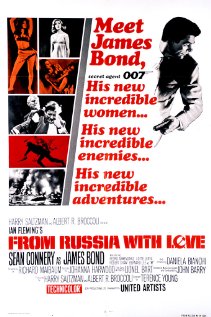
| Director(s) | Terence Young |
| Producer(s) | Harry Saltzman, Albert R. Broccoli |
| Featured Cast | Sean Connery, Daniela Bianchi, Lotte Lenya, Robert Shaw, Bernard Lee |
| Total Facts | 76 |
"Q"/ Major Boothroyd played by Desmond Llewelyn appears for the first time. This character was played by Peter Burton in Dr. No. When Burton was unable to return for this film, the role was recast with Llewelyn in the part. Llewelyn would reprise the role of "Q" in 16 subsequent Bond films (17 performances in all, but he didn't appear in Live and Let Die. Q is referred to by his real name, "Major Boothroyd," only in Dr. No, this movie, and The Spy Who Loved Me.
Sean Connery said that this movie was his personal favorite out of the Bond films he did.
Sean Connery was outfitted for the film with eight specially tailored Saville Row suits, each one costing in the region of $2000.
Walter Gotell, who plays Morzeny, later played General Gogol in The Spy Who Loved Me and reprised the role of Gogol in 5 Bond films after that.
Pedro Armendáriz playing the role of Kerim Bey, was terminally ill during filming with the cancer he had likely contracted while filming the notorious film The Conqueror near the site of the US nuclear test site in the Utah desert. Armendariz had accepted the role in 'From Russia With Love' partially as a means of providing financial security for his widow, and the film's schedule was altered in order to film the scenes in which he appeared while he was still physically able. Towards the end of the filming of those scenes, such as the Gypsy camp battle sequence however, director Terence Young had to double for the actor in some of his long shots. One month after all his scenes were completed, Armendariz, in emulation of his friend Ernest Hemingway, committed suicide in a hospital in Los Angeles as his cancer progressed into the advanced stages.
Vladek Sheybal (Kronsteen the chess master) was a well-studied Polish actor hesitant to accept a role in a Bond film because he thought it might not be a good career move, but his friend Sean Connery persuaded him to sign on and it has helped his career enormously.
Albert R. Broccoli once named this film along with The Spy Who Loved Me and Goldfinger as his three favorite James Bond movies, according to an interview with the Hollywood Reporter's Robert Osborne. Sean Connery considers this to be the best of the Bond films.
A spin-off video-game was released a staggering forty-two years after the film was made. James Bond 007: From Russia with Love actually includes Sean Connery's likeness and he even provided the voice. It is Connery's last performance as James Bond to date and he voiced it twenty-two years after Never Say Never Again.
According to the film's CD Soundtrack sleeve notes, this film's theme song debuted in the UK Charts on 14 November 1963 and went to No. #20. In the USA, the film's soundtrack album charted on the 2nd of May 1964 and went to No. #27. A number of tracks on the album do not appear in the film whilst the main titles track on the album is different to that in the film. The soundtrack has never had an extended release with the release of extra tracks like other Bond soundtracks apparently due to the masters being lost.
Actresses considered for the role of Tatiana Romanova included Pia Lindström, Sally Douglas, Magda Konopka, Margaret Lee, Lucia Modugno, Sylva Koscina, Virna Lisi and Tania Mallet, the latter ended up getting the role of Tilly Masterston in Goldfinger. Reportedly, the producers first choice had originally been Elga Andersen but she was allegedly deemed too difficult by the studio United Artists. As such, 1960 Italy's Miss Universe Daniela Bianchi got the part. Her voice was dubbed in the film by an uncredited Barbara Jefford in order to hide her thick Italian accent.
Although he had his reservations about the choice of Sean Connery for the part of James Bond, after seeing him in this film writer Ian Fleming was completely won over by the actor.
Assistant director Kit Lambert later became a record producer and manager for the rock band The Who.
At the beginning of the film, the floor beneath the chess tournament is laid out in a 10 by 8 pattern with 80 squares instead of the standard 64 making for a wider visual shot.
Bond's trick attaché case is the first true Bond film gadget. Other "state of the art" gadgets of the time are the mobile car phone in Bond's Bentley, the miniature tape recorder in the camera, the AR7 survival rifle, the retractable garrote in Grant's watch, and the SPECTRE spring loaded shoe knives.
By the time the film opened in the US in April 1964, production was already underway on Goldfinger.
Colonel Rosa Klebb is based on an actual Russian colonel that Ian Fleming once wrote about in the Sunday Times. Katina Paxinou was the producers' first choice for the role.
During the helicopter sequence towards the end of the film, the inexperienced pilot flew too close to Sean Connery, almost killing him.
Final James Bond movie viewed by Ian Fleming.
First Bond film to end with the declaration "James Bond will return in ...", in this case it was Goldfinger. A tradition that would continue until it was used for the last time at the end of Octopussy.
In 1950, a US naval attaché was assassinated and thrown from the Orient Express train by a Communist agent. This story inspired Ian Fleming's novel "From Russia With Love". Fleming's own experience at an Interpol Conference in Istanbul, Turkey provided the setting. The film To Paris with Love provided the tile.
In the books, Bond often drives his beloved Bentley. The car appears in this film for the only time in the regular series.
In the novel, Bond is actually killed by Klebb with her shoe knife. It was intended to be the last novel because Ian Fleming was frustrated with the lack of success the novels had had. But when it turned out to be an unexpected bestseller, Fleming continued instead. He considered From Russia With Love to be the best one of all the Bond novels.
In this film, James Bond does not say "Bond, James Bond" despite the fact that he does say it in the book this film was based on.
James Bond doesn't appear until 17 minutes and 15 seconds into the movie. Red Grant's voice is first heard 1h 20m in.
Krilencu is supposed to be Bulgarian, but uses the Romanian or Moldovan spelling--the Bulgarian would be Krylenko. His hideout is behind a billboard advertising Call Me Bwana, also produced by Albert R. Broccoli and Harry Saltzman.
Kronsteen's death, the boat chase, the opening sequence with the fake Bond being killed by Red Grant, and all scenes with Blofeld were not in the original novel. These were inventions of the film version, most of which due in part to the fact that the main enemy agency was changed to the fictitious SPECTRE (SPecial Executive for Counter-intelligence, Terrorism, Revenge and Extortion) rather than SMERSH (Shmert Spionam=Death to Spies), which at one time was a real Soviet counterintelligence agency.
Location manager William Hill was forced to play the role of the real Captain Nash when the actor hired for the role couldn't make it at the last minute.
Much of the film was shot on location, with only a bare minimum of back projection used. Something quite unusual for a film of 1963.
On the Istanbul ferry journey, the Maiden's tower can be seen in the distance behind Bond. This was Renard's lair in The World Is Not Enough.
On-screen body count: 21. This does not include the real Captain Nash, who is presumably killed by Grant off-camera, and Morzeny, who is seen burning following the explosion of the fuel tanks in the Adriatic, but not clearly seen to be dead.
Over 3,500 onlookers flocked to the Sirkeci Railway Station in Istanbul to watch the filming. Overcrowding caused delays in shooting due to such an unexpected turnout. As such, director Terence Young had stuntman Peter Perkins go and create a distraction by hanging upside from a balcony nearby so filming could proceed.
Product placements, brand integrations and promotional tie-ins for this movie include Rolex Watches, James Bond wears a Rolex Submariner; Taittinger Blanc de Blanc Champagne; a billboard advertising another movie made by the Bond producers Harry Saltzman and Albert R. Broccoli called Call Me Bwana starring Anita Ekberg and Bob Hope; and Bentley motor vehicles, James Bond drives a Derby Bentley Mark 4 ½ Liter Sports Tourer convertible, the only time he drives a Bentley in the Eon Productions series.
Red Grant has no dialog until he first meets Bond, first speaking in a rich, upper class English accent. After he's revealed his true identity to Bond, Grant's English accent changes into a lower-class Irish accent as he is explaining the SPECTRE background plot.
Regular James Bond production designer Ken Adam could not work on the film as he was unavailable due to going to work on Stanley Kubrick's Dr. Strangelove or: How I Learned to Stop Worrying and Love the Bomb.
Some rumored reports maintain that James Bond creator Ian Fleming makes small appearance in this film standing next to the Orient Express train. He is allegedly wearing grey trousers and a white jumper and stands on the platform to the right side of the train. Some sources deny that he appears.
The boat chase at the end of the movie, although supposed to be taking place in the Greek archipelago, was actually filmed in the West of Scotland. The pier James Bond takes off from is at Lunga House and the scene where the flaming barrels are thrown off the boat in Loch Craignish Ardfern, Argyll.
The brutal fight in the train compartment between James Bond and Red Grant lasts only a few minutes on screen and took three weeks to film. Most of it was performed by the actors themselves, rather than doubles.
The budget was $2,000,000 (double that of Dr. No).
The chess tournament set appearing at the beginning of the film cost $150,000. The ceiling top of the chess set was actually a matte painting.
The collapsing rifle given to Bond isn't a gimmick, but was an Armalite AR-7 survival rifle which was a production item which actually does disassemble and fit into its stock. However it fires the .22 long rifle cartridge, not .25 caliber as was stated in the film. As of 2005, it is still in production, although not by Armalite. It is one of very few firearms that will float when dropped into water.
The film's storyline deals with the Lektor Decoding Machine, the name of which was called the Spektor Decoding Machine in the original Ian Fleming novel. Its name was changed because of its similarity with the name of the fictitious criminal spy organization "Spectre". He based this device on his knowledge of the Enigma Decoding Machine from World War II. Fleming was involved with the Ultra Network who cracked the Enigma Code in 1939. The Ultra Network's activities were not released until 1975 in a book called A Man Called Intrepid. Fleming's friend Sir William Stevenson wrote the book which was published at the time when the closed period on wartime secrets expired and the records were finally declassified.
The film's title song "From Russia With Love" sung by Matt Monro can be heard on the radio when James Bond and Sylvia Trench are sitting in a boat having a picnic. This song was the first ever James Bond title song to receive a Best Song Golden Globe nomination. A number of others would follow for Bond movies. A cover version of this song sung by Natacha Atlas can be heard on the David Arnold Bond song compilation album, "Shaken and Stirred: the David Arnold James Bond Project".
The first line of the Ian Fleming James Bond novel "From Russia with Love" reads: "The naked man who lay splayed out on his face beside the swimming pool might have been dead." The last line reads: "He said, or thought he said, 'I've already got the loveliest...'. Bond pivoted slowly on his heel and crashed headlong to the wine-red floor."
The gadget Bond uses to check his hotel telephone for bugs is actually a device called an Elcometer. It is used to check the thickness (in thousandths of an inch) of surface coatings, usually paint, on ferrous surfaces. The needle moves sharply across the scale because, though the bodies of that type of telephone were plastic, their bases were painted steel.
The garden setting in the opening sequence was inspired by L'année dernière à Marienbad which had a lush garden setting with statues. It was actually the garden at Pinewood Studios and director Terence Young had the garden recreated in principal from the art house classic.
The headquarters of criminal spy organization SPECTRE in this film is actually the main office administration building of Pinewood Studios.
The helicopter (carrying director Terence Young during filming) crashed over water, trapping the director below the surface for a considerable time in an air bubble inside the copter's canopy. He was rescued and then immediately went back behind the camera with his arm in a sling.
The helmsman of the lead SPECTRE powerboat pursuing Bond is Peter Twiss OBE DSC who, in 1956, flew the Fairey Delta 2 aircraft to a new world air speed record of 1,132 mph. At the time of the shooting of the film he was working for Fairey Marine at Hamble, Hampshire, the manufacturer of the powerboats used. Mr. Twiss details his role in the film in his autobiography "Faster then the Sun". He describes a misunderstanding between Sean Connery and Terence Young regarding timing during the fuel explosion sequence which resulted in a re-shoot after 2 days delay.
The hulking blond assassin Red Grant provided a template for a number of blond European henchmen that would proliferate the James Bond series in later movies such as Hans in You Only Live Twice; Erich Kriegler in For Your Eyes Only; Venz in A View to a Kill; Necros in The Living Daylights; Peter Franks in Diamonds Are Forever and Stamper in Tomorrow Never Dies.
The James Bond ally character of Ali Kerim Bey was known as "Darko" Kerim Bey in the original Ian Fleming novel of the same name.