Cleopatra (1963) Facts
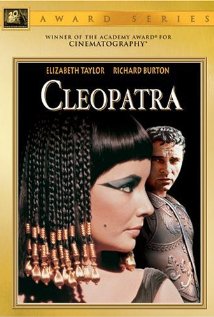
| Director(s) | Joseph L. Mankiewicz, Rouben Mamoulian (uncredited), Darryl F. Zanuck (uncredited) |
| Producer(s) | Walter Wanger, Peter Levathes (uncredited) |
| Featured Cast | Elizabeth Taylor, Richard Burton, Rex Harrison, Pamela Brown, George Cole |
| Total Facts | 89 |
Marlon Brando was sought for the role of Marc Antony but was attached to Mutiny on the Bounty.
Robert Stephens said in a radio interview that most of his part was deleted from the final print.
Hume Cronyn was originally signed to be on the film for 10 weeks. He stayed with the production for 10 and a half months.
Elizabeth Taylor became the first actress to earn a million dollars when she agreed to star in this film. Her overall take of seven million is equivalent to about 29 million in 2009 dollars.
Elizabeth Taylor had 65 costume changes for this film, a record for a motion picture. The figure is exceeded by Joan Collins, who had 85 costume changes in the TV miniseries Sins.
Elizabeth Taylor had met Richard Burton several years prior to their working together on the film; she had found him to be brutish and boorish. However, when Burton showed up for work on Cleopatra on his first day, it was with a hangover so severe that he had the shakes. Taylor had to help him around and administer to such basic needs as helping him drink a cup of coffee. This time, she found him to be very endearing.
Elizabeth Taylor reputedly threw up the first time she saw the finished product.
Elizabeth Taylor's contract gave her director approval. When Rouben Mamoulian resigned from the production, Taylor would only approve two men as possible replacements: George Stevens and Joseph L. Mankiewicz. Stevens was already at work on The Greatest Story Ever Told.
Elizabeth Taylor's contract stipulated that her million-dollar salary be paid out as follows: $125,000 for 16 weeks work plus $50,000 a week afterwards plus 10% of the gross (with no break-even point). When the film was restarted in Rome in 1961, she had earned well over $2 million. After a lengthy $50 million lawsuit brought against Taylor and Richard Burton by 20th Century Fox in 1963 and a countersuit filed by Taylor, the studio finally settled with the actress in 1966. Her ultimate take for the film was $7 million.
Joseph L. Mankiewicz hoped that the film would be released as two separate pictures, "Caesar and Cleopatra" followed by "Antony and Cleopatra." Each was to run approximately three hours. 20th Century-Fox decided against this, and released the film we know today. It runs just over four hours. It is hoped that the missing two hours will be located and that one day a six-hour 'director's cut' will be available.
Joseph L. Mankiewicz originally wanted to have either Laurence Olivier or Trevor Howard as Julius Caesar. Olivier had full theatrical commitments due to running the National Theatre of Great Britain, whilst Howard was caught up in the protracted filming of Mutiny on the Bounty.
Joseph L. Mankiewicz told Martin Landau that he had enough cut footage to make another movie called "The Further Adventures of Octavian and Ruffio".
Joseph L. Mankiewicz was never proud of this film and only made it out of sufferance for his friend, Elizabeth Taylor. At one point he even tried to have his name taken off. He was however paid $3 million for making it, a then unheard of sum of money for a director.
Martin Landau learned Italian during the shoot.
Martin Landau was booked to play Euphranor, but when they could not find anyone to play Ruffo, Landau was recast
Martin Landau was cast after Joseph L. Mankiewicz admired his performance in North by Northwest. Mankiewicz called up Alfred Hitchcock to ask him if he could act.
John Hoyt, who plays Cassius, the chief conspirator against Julius Caesar, played the role of Decius Brutus, another of the conspirators, in both Orson Welles's 1937 Fascist-themed stage production of Shakespeare's 'Julius Caesar', and in MGM's more traditional 1953 film version of the play.
Rex Harrison had a clause in his contract stipulating that whenever a picture of Richard Burton appeared in an ad, so would his. A large sign was put up on Broadway showing only Burton and Elizabeth Taylor. After Harrison's lawyers complained, the studio fulfilled the contract by placing a picture of Harrison on one corner of the billboard.
Darryl F. Zanuck, in principle, did not object to Joseph L. Mankiewicz's idea to have 2 3-hour movies. However, he knew the public was obsessed with the Elizabeth Taylor-Richard Burton affair and would not show up to see the first part in which Burton did not appear. Thus, the two parts were edited into one single movie.
Michael Hordern said on a chat show he was under contract for 18 months
Jack Hildyard was initially the film's cinematographer, but left at the same time as original director Rouben Mamoulian. When Joseph L. Mankiewicz came on board, he initially looked at hiring an Italian cinematographer, but the studio did not believe that there were any Italians sufficiently qualified to work on the film and pressured him to hire an American or British cinematographer. Freddie Young, Milton R. Krasner and Robert Surtees were all unsuccessfully approached for the position, before Leon Shamroy finally agreed to sign on.
Nunnally Johnson was paid $140,000 for a script polish.
Stanley Baker was set to play Ruffio but demurred over taking the part as there was no script available. By the time, he decided to take it, the part had since gone to Martin Landau.
Susan Hayward was the first choice to play Cleopatra.
Alex North was chosen to score the film after Joseph L. Mankiewicz's son Chris told him that North had done a magnificent job in composing a score for Spartacus.
John DeCuir rebuilt the massive set of Alexandria three times.
20th Century Fox's virtual bankruptcy meant that the film lacks a big final battle sequence. The studio simply couldn't afford to do one.
26,000 costumes were created for the film.
79 sets were constructed for the film.
A clerical error by 20 Century-Fox probably cost Roddy McDowall a Best Supporting Actor Academy Award nomination for his performance in this film. See McDowall's biography page for details.
A group of female extras who played Cleopatra's various servants and slave girls went on strike to demand protection from amorous Italian extras and their bottom-pinching fingers. The studio eventually hired a special guard to protect the extras.
A total of 10 people won the Academy Award for Best Art Direction (Color) for the film (7 art directors, 3 set decorators); this is the highest number of persons sharing a single award in an annual category. (In 1988 and again in 2006, a Scientific and Technical Award, which is not necessarily given each year, was shared by 12 individuals.)
Adjusting for inflation, this is one of the most expensive movies ever made. Its budget of $44 million is equivalent to 297 million 2007 dollars.
After a day's lengthy shooting, Joseph L. Mankiewicz would retire to his private rooms to carry on rewriting the screenplay. He had initially begged for time off to do a proper rewrite but 20th Century Fox was already so deeply in debt that they couldn't allow for yet another delay in production. Operating under these stressful conditions, Mankiewicz had to resort to daily injections to keep him going during the day and different ones at night to help him sleep.
After conceding to Darryl F. Zanuck's insistence that Cleopatra be one film not two, Joseph L. Mankiewicz's first cut ran to 5 hours and 20 minutes. Zanuck's first reaction to the film was that Mark Antony was ineffectual, many of the scenes were simply too long and the battle scenes were amateurish in execution.
After firing Rouben Mamoulian as director, Walter Wanger and Darryl F. Zanuck approached Alfred Hitchcock to take over the project. Hitchcock refused and chose to make The Birds instead.
Among Elizabeth Taylor's demands were the requirement that the film be shot in the large format Todd-AO system. She owned the rights to the system as the widow of Michael Todd. This meant even more money being paid to Ms. Taylor.
At $194,800, the budget for Elizabeth Taylor's costumes in this film was the highest ever for a single screen actor. Her 65 costumes included a dress made from 24-carat gold cloth.
At the height of its excesses, Cleopatra was costing 20th Century Fox $70,000 a day.
Cleopatra's barge alone cost about $2 million in today's dollars.
Cleopatra's spectacular entrance into Rome was nearly scuppered when all the enthusiastic extras started shouting "Liz! Liz!" instead of "Cleopatra! Cleopatra!".
Director Joseph L. Mankiewicz referred to this as "the toughest three pictures I ever made".
Director Joseph L. Mankiewicz was fired during the editing/post-production phase. Since there was no actual shooting script (Mankiewicz was writing as he was shooting), Twentieth Century-Fox soon realized that only Mankiewicz knew how the story fit together. He was brought back to complete the project.
During Cleopatra's entry into Rome, the shots of Cleopatra's barge and the parade that precedes it were filmed several months apart, so that the light would be hitting Cleopatra directly.
During production 'Spyrous Skouras' sold a thousand of his estimated 100,000 shares in the studio on a whim. When rumors of his lack of faith in the studio began to spread, the chairman had to buy them back in order to squelch the stories.
During the making of the movie, Elizabeth Taylor and Richard Burton started their love-hate relationship which lasted until his death.
Filming began in 1960.
First cinema film of John Alderton.
For many of the reshoots, original cinematographer Leon Shamroy was unavailable so Claude Renoir filled in for him.
Fox's marketing campaign was suitably successful that on the day that Cleopatra finally opened, the film was sold out for the next four months.