Cleopatra (1963) Facts
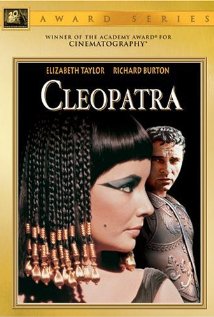
| Director(s) | Joseph L. Mankiewicz, Rouben Mamoulian (uncredited), Darryl F. Zanuck (uncredited) |
| Producer(s) | Walter Wanger, Peter Levathes (uncredited) |
| Featured Cast | Elizabeth Taylor, Richard Burton, Rex Harrison, Pamela Brown, George Cole |
| Total Facts | 89 |
In 1958 Joan Collins was cast in the title role, but after several delays she became unavailable. Collins had previously starred in a similar role in Land of the Pharaohs. After Collins' departure, Audrey Hepburn was considered as a replacement by producer Walter Wanger. Wanger then offered the role to Elizabeth Taylor. He called her on the set of her latest film, Suddenly, Last Summer and related the offer through Taylor's then husband Eddie Fisher who had answered the phone. As a joke, Taylor replied "Sure, tell him I'll do it for a million dollars." This then unheard-of sum was accepted and in October 1959 Taylor became the first Hollywood star to receive $1 million for a single picture.
In 1966, ABC-TV paid 20th Century-Fox a record $5 million for two showings of the film, a deal that finally put the picture into the black.
In order to break even, Cleopatra had to become one of the top grossing films of all time. Its initial box office take in North America was $48 million, the highest grossing film of its year. 20th Century Fox's share of the receipts amounted to only $26 million, however, only half of the total production costs. The film eventually recouped its budget through worldwide box office takings and television sales, but the studio had to undertake drastic cost-cutting measures to survive. It was only due to the success of The Longest Day and the following year's The Sound of Music that the studio managed to stay afloat.
In order to keep star Elizabeth Taylor happy, 'Spyrous Skouras' had chili from Chasen's air-freighted to Europe for her.
Initially Egypt refused entry to Elizabeth Taylor because she was Jewish. They revised their opinion after reflecting on the millions of US dollars that the film's presence would engender.
Mitchell, not Panavision, cameras were used on "Cleopatra".
Numerous boats and ships were employed for the scene showing Cleopatra's navy. It was said at the time that 20th Century Fox had the world's third biggest navy.
One of Cleopatra's handmaidens is a 16 year old Francesca Annis.
One of the beleaguered director Joseph L. Mankiewicz's most passionate allies was Rex Harrison who, at one point, offered up his own salary to see if it would help the production. Mankiewicz refused to let him do that.
One of the problems frequently encountered was that Italian films at the time were all post-dubbed. Consequently while Joseph L. Mankiewicz was attempting to film his scenes, there was invariably constant hammering going on by the carpenters on the set. The production lost hours and hours, trying to make it clear to the Italian crew that silence was essential on set at all times.
Originally Cleopatra was envisioned as a modest $2,000,000 project starring Joan Collins. However, once Elizabeth Taylor was cast, the film was transformed into a giant epic.
Soon after shooting began in England, Elizabeth Taylor became ill and could not work. As her presence was required for almost every scene production soon closed down. Director Rouben Mamoulian finally resigned on January 3, 1961. He was followed by stars 'Peter Finch' and Stephen Boyd, who had to honor prior commitments.
Taylor's illness prevented her from working again in England's weather for several months. Therefore the production moved to Rome. The sets and the footage already shot were scrapped. (See also Carry on Cleo).
The blasting review that Judith Crist gave the film effectively kickstarted her film critic career.
The dragged-out production cost Martin Landau a part in Federico Fellini's 8½.
The film's elaborate and complicated sets and props all had to be constructed twice, as the production moved from London to Rome following Elizabeth Taylor's illness.
The filming of Cleopatra's entrance into Rome was delayed for months due to lighting problems resulting in the recasting of the American child actor who was playing her four-year-old son with an Italian child (complete with accent) as the original boy had grown taller during the long delay.
The finished script was as thick as the Beverly Hills phonebook.
The first of eleven theatrical films that Elizabeth Taylor and Richard Burton starred in together.
The first screenwriter drafted in on the film was industry veteran Nigel Balchin.
The original list of choices for the role of Marc Antony were Stephen Boyd, Richard Johnson, Michael David, Peter O'Toole, Peter Finch and Laurence Harvey. Boyd was cast as Antony while Finch was cast as Caesar. However, both men had to leave the project due to the lengthy delays and their obligations to other projects. Boyd was replaced by Richard Burton and Finch was replaced by Rex Harrison.
The production was so huge and demanded so much lumber and raw material that building materials became scarce throughout the rest of Italy.
The Roman forum built at Cinecitta was three times the size of the real thing.
The scar from Elizabeth Taylor's tracheotomy, performed during filming, is visible in several shots.
This film has been cited as one of the factors that brought an end to the Italian-made "sword and sandal"/"mythological muscleman" epics that had been popular since the late 1950s. Specialized suppliers raised their prices for goods and services supplied to this production. The higher prices were beyond the budget of Italian producers so production values for their films dropped and audiences declined.
Twentieth Century Fox was in financial trouble in the late-1950s due to disappointing box office returns of some major releases. Orders were given to search the Fox script library for a proven property that could be remade. The project chosen was Cleopatra, a Theda Bara film that had been a smash hit for the studio. What the studio needed was a producer willing to handle the project. At about the same time, veteran producer Walter Wanger approached Fox with an idea for a project he had been planning for several years: the story of Cleopatra. In the words of David Brown, "We fell on him."
Various employees of Rome's Cinecitta studios where this was filmed stole several millions of dollars worth of equipment and props while production took place.
When Joseph L. Mankiewicz came on board as director after the departure of Rouben Mamoulian, he inherited a film that was already $5 million over budget and with no usable footage to show for it.
When Joseph L. Mankiewicz was tapped to direct, he was working on adapting Lawrence Durrell's Alexandria quartet novels.
When Walter Wanger's first choice for director insisted that Caeser was a homosexual, 'Spyrous Skouras' told the producer not to hire him. Skouras reasoned, "To hell with history. I want a triangle with two men and one woman. Having one of the greatest men in history as a homo isn't box office!"
When Fox employees were searching for a successful Fox property that could be remade, they decided upon Cleopatra, a silent epic starring Theda Bara. However, they could only made their judgment from an archived copy of the original script and some stills from the production. There were no prints surviving of the movie itself.
When producer Walter Wanger was removed from the production, it marked the end of his career in the motion picture industry.
When studio execs suggested that Joan Collins, Dana Wynter, Sophia Loren, or Susan Hayward should be substituted for a problematic Elizabeth Taylor, 'Spyrous Skouras' allegedly screamed, " Cleopatra must have a chest. A chest will mean $1,000,000 or $2,000,000 extra dollars for us."
When the Marilyn Monroe vehicle "Something's Got to Give" was shelved due to budget overruns and the unreliability of its star, Cleopatra became the only film in production at 20th Century Fox. Obviously a lot was riding on it.
When the film finally broke even in 1973 (due to a $5 million sale to TV), 20th Century-Fox "closed the books" on "Cleopatra", therefore keeping secret all future profits from the film to avoid paying those who might have been promised a percentage of the net profits.
When the film was truncated from a 6 hour movie to a 4 hour one, 49 pages of reshoots were required to make sense of the changes.
When they built the Alexandria set at Anzio, a couple of construction workers were killed by an unexploded mine left over from World War II.
While at Cinecitta studios filming the scene of Cleopatra's triumphant and spectacular entry into Rome, a scene requiring thousands of extras and the transportation of a huge barge carrying the Queen of Egypt, Joseph L. Mankiewicz had to cut the scene, roll back the barge, and begin again because one of the production's Panavision cameras had caught an enterprising film extra, in the heat of the Roman summer, hawking gelato to his fellow extras.
Widely regarded as one of the biggest flops of all time, reality is quite different: the film made its money back despite the horrendous costs, but not all at once - it took several years. It was one of the highest grossing films of the 1960s. According to the late director Joseph L. Mankiewicz, many of the best scenes were cut and there are between 90 and 120 minutes of character development and story missing.