Home> Facts and Trivia > Stars > Paul Robeson
Paul Robeson Facts
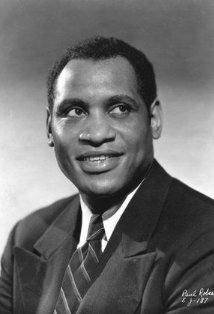
| Sign | Aries |
| Born |
Apr 9, 1898 Princeton, NJ |
| Died |
Jan 23, 1976 Philadelphia, PA |
| Age | Died at 77 |
| Total Facts | 39 |
According to the biography written by his son, Paul Robeson Jr., he had a long-term extramarital relationship with Fredi Washington. They appeared in one film together, The Emperor Jones (1933).
Although he changed the lyrics of "Ol' Man River" in 1938 to reflect his own personal and political views, and although the recordings he made of the song after 1938 use those altered lyrics, Robeson always sang the song as originally written by Jerome Kern and Oscar Hammerstein II in the stage productions of "Show Boat" in which he appeared, as well as in the 1936 film version (with the exception of the word 'niggers", which, in the film, was changed to "darkies").
Although he did give a few interviews on television, he never played any dramatic or musical roles in that medium.
Appeared in a World War II-era U.S. Government War Department propaganda film aimed at combating the spread of venereal diseases among black soldiers. The film was called "Easy to Get" (serial number T.F.8 1423), and Robeson appears at the end in his capacity as a celebrity football star and singer to advise viewers to stay "clean.".
Attempted suicide at a party in 1961. His son Paul Robeson Jr. believes his father had been drugged by the CIA.
Elected to Phi Beta Kappa at Rutgers in 1919.
Elected Valedictorian of his senior class at Rutgers, 1919.
Graduate of Columbia University School of Law.
Has a black tomato variety named after him, allegedly named so by its Russian growers because he was extremely well liked in that country. (source: tomatofest.com)
He was a member of Phi Beta Kappa.
He was awarded the 1953 Stalin Peace Prize by the Soviet government. He was the last one to receive it before it was renamed the Lenin Peace Prize a few years later.
He was captain of the Rutgers debating team.
He was elected into the 2008 New Jersey Hall of Fame for his contributions to History.
His father was William Drew Robeson, a minister. His mother was Maria Louisa Bustill (? - 1904).
In 1925, he sang the first concert recital consisting solely of black spirituals, at the Greenwich Village Theatre in New York.
In 1942, said he wouldn't make any more films until there were better roles for blacks.
In 1952 and 1953 he sang in defiance of the U.S. government in what is now called "The Peace Arch Concerts." These concerts, attended by over 40,000 people, are now available on CD and feature Robeson's only political speeches on record along with his signature song, "Old Man River."
In December 1937 he sang a whole night for Spanish Republican troops fighting to take the town of Teruel.
In its time, the Robeson "Othello" could not have been filmed because of the racial climate of the era - a black man could not play a love scene with a white woman in a motion picture in the 1940s. In addition, Robeson was blacklisted for his political beliefs in 1950, and as a result, was not able to make any films in the U.S., or have any of his films shown in the U.S. at that time.
In stage productions he acted William Shakespeare's "Othello" as it was written, but when he performed Othello's final speech at his concert recitals, he changed the famous phrase "one that lov'd not wisely, but too well" to "one that lov'd full wisely, but too well".
Inducted into the National College Football Hall of Fame.
Inducted into the Rutgers Football Hall of Fame.
Member of Alpha Phi Alpha Fraternity, Inc.
Nearly died from double pneumonia and a blocked kidney in 1965.
Pictured on a 37¢ USA commemorative postage stamp in the Black Heritage series, issued 20 January 2004.
Played football professionally for three years in the APFL (American Professional Football League) 1920-1922.
Portrayed by Avery Brooks in a 1982 revival of the 1976 theater production about his life.
Portrayed by James Earl Jones in a 1976 theatre production about his life. Jones sang in the production, despite the fact that he does not possess a real "singer's voice". This one-man show was eventually telecast on PBS.
Robeson made only one stereo recording, a two volume set of his historic 1958 Carnegie Hall recital - his only appearance there. Unfortunately, the albums made from this occasion turned out to be his last. The Carnegie Hall concert has since been issued on CD, and shows him in remarkably good voice for a sixty year old singer.
Robeson was only the third black person to attend Rutgers University, the state university of New Jersey.
Robeson was the first black person to play football for Rutgers University.
Robeson was twice Named All-American Football Player for Rutgers at End, in 1917 and 1918.
Subject of 2001 Manic Street Preachers single 'Let Robeson Sing' (from the album Know Your Enemy)
The 1943 Broadway production of "Othello", in which Robeson starred is, to this day, the longest-running non-musical production of a Shakespeare play ever to be staged in the United States, due almost entirely to Robeson's enormous popularity at the time. "Kiss Me Kate", inspired by "The Taming of the Shrew", "West Side Story", inspired by "Romeo and Juliet", and the musical version of "Two Gentlemen of Verona", based on Shakespeare's comedy of the same name, all ran longer, but the 1943 "Othello",a "straight" production of the play, ran for nine months at the same theatre, and then went on a highly successful U.S. tour.
The role of Joe, the deckhand, in Jerome Kern's and Oscar Hammerstein II's "Show Boat" was written for him, but because of schedule conflicts and Florenz Ziegfeld Jr.'s delay in putting on the show, he was unable to star in the first stage production and played the role in London five months later. He sang "Ol' Man River" in the show, and made the second ever recording of the song ever in 1928 (Bing Crosby did the first), the same year he starred in the show. He became so identified with it that he starred in three more productions of "Show Boat": the 1932 New York revival, the 1936 film version and a 1940 Los Angeles stage production. Although he continued singing "Ol' Man River" in every one of his solo recitals, and made at least two more recordings of the song, he began changing the lyrics after 1938 to reflect his more racially conscious views.
The subject of the World/Inferno Friendship Society song, "Paul Robeson". Contains the rousing chorus "Speak Up/Black Out/Black Listed/Full bodied - red".
Was able to speak and write in over 20 languages.
Was investigated by the California Senate's Fact Finding Committee on Un-American Activities (colloquially known as the "Tenney Committee" after Committee Chairman Jack Tenney). The Tenney Committee investigated alleged communists in California.
Was the subject of the song "Paul Robeson (Born To Be Free)" by the Celtic rock group, Black 47.