Home> Facts and Trivia > Stars > Harpo Marx
Harpo Marx Facts
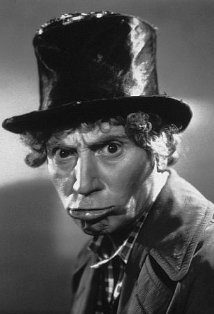
| Sign | Sagittarius |
| Born |
Nov 23, 1888 New York City, NY |
| Died |
Sep 28, 1964 Los Angeles, CA |
| Age | Died at 75 |
| Total Facts | 31 |
Groucho Marx gave this reason for Harpo's silence: Once, while playing a theater in Winnipeg, Manitoba, during a vaudeville tour, The Marx Brothers had a disagreement with the theater's manager regarding their pay. At the end of The Marx Brothers' engagement there, the manager paid them the amount they had demanded...in several large sacks containing the proper amount in the form of pennies, nickels, and dimes. Since the brothers' train was departing in ten minutes, the brothers had no choice except to lug the sacks onto the train with them. As the train departed, Harpo shouted to the manager, "I hope your theater burns to the ground." And that night, it did. Groucho always said that Harpo's voice was like the axe hanging on the backstage wall of every theater: To be used only in case of emergencies.
W.C. Fields said that The Marx Brothers were the only act he couldn't follow on the live stage. He is known to have appeared on the same bill with them only once, during an engagement at Keith's Orpheum Theatre in Columbus, OH, in January 1915. At the time the Marx Brothers were touring "Home Again", and it didn't take Fields long to realize how his quiet comedy juggling act was faring against the anarchy of the Marxes. Fields later wrote of the engagement (and the Marxes), "They sang, danced, played harp and kidded in zany style. Never saw so much nepotism or such hilarious laughter in one act in my life. The only act I could never follow . . . I told the manager I broke my wrist and quit.".
Adopted father of Bill Marx, Alexander Marx, Minnie Marx and Jimmy Marx, from his marriage to Susan Fleming
After his death, he was cremated and his ashes were allegedly sprinkled into the sand trap at the seventh hole of the Rancho Mirage golf course in California, USA where he used to play golf on a monthly basis.
Although it is popularly believed that Harpo never spoke on film, he is faintly heard in the newsreel footage during the premiere of MGM's "The Great Ziegfeld" in 1936. He approaches the microphone without his wig and make-up and says to W.C. Fields just out of range of the mic: "You gotta do the talkin'." Harpo leans in to the mic after Fields finishes speaking, and loudly says: "Honk! Honk!".
As a child, Harpo was apparently infatuated with music. He rejoiced when his family bought a piano. He then fell into dispair when he found out that they could only afford to let one brother have piano lessons. His brother Chico Marx ended up with the lessons, which he did not take seriously. Harpo, of course, later mastered the harp.
At the beginning of the film Monkey Business (1931), The Marx Brothers, playing ship's stowaways concealed in barrels, are first introduced harmonizing unseen, singing the popular song "Sweet Adeline." And although he is cannot be seen, this musical performance marks the only time during one of The Marx Brothers' movie that Harpo's voice -- a clear and pleasant baritone -- is ever heard.
Brother of Groucho Marx, Chico Marx, Zeppo Marx, and Gummo Marx.
Brother-in-law of Barbara Marx, Ruth Johnson, Kay Marvis and Eden Hartford,
Died on the day of his 28th wedding anniversary.
Great-uncle of Jade Marx-Berti, Gregg Marx, Laura Guzik and Brett Marx
Harpo first using the gag of chasing a screaming girl as a quick prank to throw his brother Groucho Marx's timing off on stage. Groucho wasn't fazed, but Harpo got in trouble when he found out the hard way that the girl had a violent mobster for a boyfriend. He quickly made peace with the man and incorporated the girl chasing for the rest of his career.
Harpo officially became a mime after a theater critic once noted in the early 1920s that Harpo was brilliant until his character spoke. His naturally deep, mature voice ruined the profile of his zany and child-like character. From then on, Harpo never spoke while in character.
Harpo was vacationing in the French Riviera and was engaged in nude sunbathing when he was surprised by an elderly man and woman. He wrapped his towel around his middle and stood up and introduced himself. The husband introduced himself as George Bernard Shaw, the famous writer and philosopher. Without warning Shaw snatched the towel away and then said, "And this is Mrs. Shaw!" It was the start of a lifelong friendship.
He and Chico were usually mistaken as twins when they were young.
He was portrayed by actor Daniel Fortus in the Broadway musical "Minnie's Boys," which ran at the Imperial Theatre for 80 Performances from Mar 26 to May 30, 1970.
He was voted, as one of The Marx Brothers, the 62nd Greatest Movie Star of all time by Entertainment Weekly.
Is portrayed by 'J.M Henry' in Mrs. Parker and the Vicious Circle (1994).
Legally changed his given name to Arthur around 1911 because he much preferred it to the very German Adolph.
Nephew of actor Al Shean.
Once crashed a Hollywood costume party at the home of Marion Davies, dressed as Kaiser Wilhelm II. He had to hitchhike to get home and ended up being arrested by Beverly Hills police on charges of vagrancy, illegal entry, escaping from jail in Gloversville, New York, impersonating Kaiser Wilhelm II, and impersonating Harpo Marx.
One of only two Marx Brothers to play a recurring role in their films (not counting when they used their own names). He played the role of "Pinky" in both Horse Feathers (1932) and Duck Soup (1933).
Recreated the mirror scene from Duck Soup (1933) in an episode of "I Love Lucy" (1951).
Served as the basis for the character Banjo in the long-running comedy "The Man Who Came to Dinner" by George S. Kaufman and Moss Hart. The play had one of its most memorable productions at the Bucks County Playhouse in Pennsylvania, where Kaufman played Sheridan Whitside (the character based on critic Alexander Woollcott, Hart played Beverly Carlton (the character based on Noel Coward, and Harpo played Banjo, speaking his first lines on stage in over twenty years.
Son of Sam Marx and Minnie Palmer.
The character of Banjo in George S. Kaufman and Moss Hart's play "The Man Who Came to Dinner" is based on Harpo.
Uncle of Arthur Marx, Miriam Marx, Bob Marx, Maxine Marx, and Melinda Marx.
Unmade-up and out of costume, the resemblance between Harpo and his brother Chico Marx was extraordinary. On the TV game show "I've Got a Secret" (1952), Chico once appeared in Harpo's wig and costume, with the "secret" "I'm Pretending To Be Harpo Marx (I'm Chico)" and fooled all the panelists -- including Groucho Marx.
Was cousin of Sadie Marks - better known as Mary Livingson; brother-in-law of Benjamin Kubelsky, aka Jack Benny.
Was seldom recognized when out of character because he was almost completely bald.
When he trained himself in the harp, he later learned that he did it the wrong way. However, when he became famous, many musicians came to him to learn his method of harp playing.