Facts > Films > Who's Afraid of Virginia Woolf?
Who's Afraid of Virginia Woolf? (1966) Facts
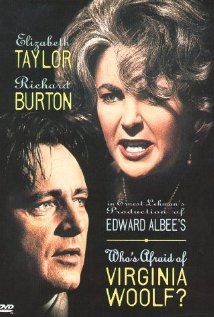
| Director(s) | Mike Nichols |
| Producer(s) | Ernest Lehman |
| Featured Cast | Elizabeth Taylor, Richard Burton, George Segal, Sandy Dennis |
| Total Facts | 38 |
Elizabeth Taylor gained nearly 30 pounds to play the role of a middle-aged wife just for this film.
Connie Stevens, who was under contract to Warner Bros. at the time of the film's casting, pleaded with studio head Jack L. Warner for the part of Honey.
Richard Burton celebrated his 40th birthday on the set of the film where spouse Elizabeth Taylor presented him with a white 1966 Oldsmobile Toronado.
Richard Burton was heavily criticized for playing his character with an English accent.
Jack Lemmon was the only actor to be offered the role of George in Who's Afraid of Virginia Woolf? before Richard Burton was cast. He accepted the role but quickly changed his mind the next day without offering any explanation.
Mercedes McCambridge had portrayed "Martha" onstage and sought after the film role.
Sandy Dennis, who was pregnant at the time of filming, suffered a miscarriage on the set.
Robert Redford turned down the role of Nick.
Edward Albee said he came up with the title when he saw the phrase written on a men's room wall in a New York tavern.
Frank Flanagan, who appears uncredited as the motel/café innkeeper, was the film's gaffer. The woman who plays his wife is actually his real-life wife Agnes who was Elizabeth Taylor's hairdresser on the film.
Willard Maas and Marie Menken and their relationship were the basis for the characters of George and Martha.
18th July 1966: Police seized this film, and arrested the manager of a local Nashville cinema, for contravening a municipal order that banned films, as this, for contents of an obscene nature.
A copy of Virginia Woolf's 'To the Lighthouse' can be seen on the bookshelf above the liquor bottles.
Academy Award-winning cinematographer Harry Stradling Sr. was replaced by Haskell Wexler just after filming began for attempting to "beautify" Elizabeth Taylor.
According a 2005 interview with Edward Albee, the original writer of the play which the film is based, producer Ernest Lehman hired himself to write the screenplay for $250,000. Also, Albee says that when director Mike Nichols and stars Richard Burton and Elizabeth Taylor read the script, they hated it so much that, unknown to Lehman, they changed all of the dialog back to Albee's play save two lines: "Hey, let's go to the roadhouse!" and "Hey, let's come back from the roadhouse!" Albee said, "Two lines for $250,000, $125,000 a piece. That's pretty good."
According to Edward Albee, the only thing he doesn't like about the film is the over-use of over-head shots. He did say, however, that he envisioned Bette Davis and James Mason as Martha and George rather than Taylor and Burton. If Davis had been cast, she would have ended up parodying a line from one of her old films ("What a dump!") in the opening scene.
According to director Mike Nichols, actress Marlene Dietrich visited the set and completely ignored Elizabeth Taylor, only speaking with Richard Burton and Nichols. Elizabeth later commented "It's a very strange thing to be ignored on your own movie set."
According to director Mike Nichols, producer/screenwriter Ernest Lehman had written a different ending for the film where George and Martha's son had hung himself in the closet years before. Nichols refused to shoot it.
Although the title was obviously inspired by the song "Who's Afraid Of The Big Bad Wolf?" (sung in the Disney cartoon The Three Little Pigs), Warner Bros. was unable to negotiate use of tune, so when characters sing the title phrase it is illogically set to melody of the public domain folk song "Here We Go 'round the Mulberry Bush."
Costing $7.5 million, it was the most expensive black & white movie yet made in the U.S. Elizabeth Taylor, Richard Burton and Edward Albee's combined salaries/fees were (not including percentages): $2,350,000 - $1,100,000 for Taylor, $750,000 for Burton and $500,000 for Albee.
Director-choreographer Herbert Ross staged the dance sequence between Elizabeth Taylor and George Segal at the roadside café.
During shooting, Elizabeth Taylor and Richard Burton used identical red bicycles, lettered in gold, to get around the huge Warner Bros. studio lot.
Early candidates for the role of Martha included Bette Davis, Ingrid Bergman, Rosalind Russell and Patricia Neal. Early candidates for the role of George included James Mason, Cary Grant, Henry Fonda, Arthur Hill, Jack Lemmon and Peter O'Toole.
Every credited member of the cast received an Academy Award nomination.
In 2007, the American Film Institute ranked this as the #67 Greatest Movie of All Time. It was the first inclusion of this film on the list.
In addition to Sleuth and Give 'em Hell, Harry!, only one of three films in which entire on-screen billed cast received acting Oscar nominations. (Although Sleuth's credits did contain a number of nonexistent phony cast members to mislead audiences into thinking it was more than a two-character thriller and Virginia Woolf did feature two unbilled bit players as roadhouse employees.)
In her A&E Biography special, Elizabeth Taylor remarked that her performance as Martha remains her personal best.
In this film, Elizabeth Taylor does an exaggerated impression of Bette Davis saying a line from Beyond the Forest: "What a dump!" In an interview with Barbara Walters, Bette Davis said that in the film, she really did not deliver the line in such an exaggerated manner. She said it in a more subtle, low-key manner, but it has passed into legend that she said it the way Elizabeth Taylor's delivered it in this film. During the Barbara Walters interview, the clip of Bette Davis delivering the line from Beyond the Forest was shown to prove that Davis was correct. However, since people expected Bette Davis to deliver the line the way Elizabeth Taylor had, she always opened her in-person, one woman show by saying the line in a campy, exaggerated manner: "WHAT ... A... DUMP!!!". It always brought down the house. "I imitated the imitators", Davis said.
On the back of the movie tie-in paperback of the play, it reads: "A Warner Bros. Technicolor film - even though the film was shot in black & white".
The first film to use the word "bugger" in its dialogue.
The first movie to be given the MPAA tag: "No one under 18 will be admitted unless accompanied by his parent."
The first movie to successfully challenge the Production Code Office and eventually force the Motion Picture Association of America to overhaul the Production Code Seal with the eventual classification system (G-GP-M-X) in 1968.
The fourth of eleven films that Elizabeth Taylor and Richard Burton starred in together.
The MPAA insisted on the removal of the term "screw you" from the film where it was replaced with the term "God damn you" but allowed the terms "screw" and "hump the hostess" to remain in the film.
The only Best Picture Academy Award nominee to be nominated for every award category in which it was eligible.
The original Broadway stage production of "Who's Afraid of Virginia Woolf" by Edward Albee opened at the Billy Rose Theater on October 13, 1962 starring Arthur Hill and Uta Hagen and ran for 664 performances.
The record changer turntable shown on the corner shelf is a Glaser-Steers model.
When the film was shown on network television for the first time, some local television affiliates bumped the broadcast from 9:00 P.M. to 11:30 P.M., because a film with such adult language had never been shown on network TV.