Facts > Films > Valley of the Dolls
Valley of the Dolls (1967) Facts
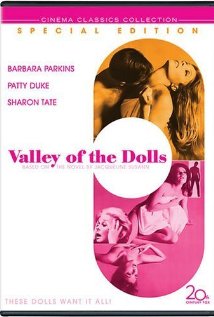
| Director(s) | Mark Robson |
| Producer(s) | David Weisbart, Mark Robson |
| Featured Cast | Barbara Parkins, Patty Duke, Sharon Tate, Martin Milner, Charles Drake |
| Total Facts | 31 |
"Come Live With Me", written by André Previn, was inspired by the Christopher Marlowe poem of the same name.
Judy Garland complained about the press writing about her behavior on this film. She said: "The studio hadn't even built the set yet, and the tabloids had me walking off it".
Judy Garland kept her costume when she was fired from the film, and proceeded to wear the sequined pantsuit while performing in concerts around the world.
Judy Garland was originally cast in the main supporting role of Helen Lawson. The studio provided her with a pool table in her dressing room at her request. Eventually she was fired from the film because of her drinking and behavior and was replaced by Susan Hayward. Other actors considered as replacements were Tammy Grimes and Bette Davis. Reportedly Garland and Ethel Merman inspired the Lawson character.
Judy Garland was originally screen-tested and signed to play the main supporting role of Helen Lawson. The studio even provided her with a pool table in her dressing room at her request. Eventually she backed out of the film and was ultimately replaced by Susan Hayward. She kept her costume when she walked off the film, and proceeded to wear the sequined pantsuit while performing in concerts around the world. The character of Neely O'Hara in the film was partially based on her own history (with pills, alcohol, and failed marriages). Sadly, it was Garland's real-life pill addiction that contributed to her leaving this film.
Judy Garland's pre-recording of the song "I'll Plant My Own Tree" still survives today, as do her wardrobe tests.
Lucille Ball was originally considered for role of Helen Lawson, which went to _Susan Hayward (I)_ after Judy Garland left production.
Raquel Welch screen-tested for the role of Jennifer North. When she was then offered it she turned it down and was suspended by 20th Century-Fox as a result. Sharon Tate eventually took the part.
Barbara Parkins originally tested for the role of Neely O'Hara before she was cast as Anne Welles.
Marlo Thomas was also considered for the role of Anne Welles.
Dionne Warwick was under contract to a different record label than 20th so the theme on the soundtrack album was sung by Dory Previn, who also wrote the lyrics. Margaret Whiting dubbed Susan Hayward but she was also under contract to a different label, so veteran voice double Eileen Wilson sings "I'll Plant My Own Tree" on the soundtrack album.
Dionne Warwick's Scepter rerecording of the movie theme would peak at number two on "Billboard"'s Hot 100 chart in February 1968. Dionne's 45 held the second slot for a month. Without Miss Warwick's presence, the soundtrack album, released by 20th Century Fox Records, entered the "Billboard" pop albums list in January 1968, and the LP then climbed to eighth place.
An original, unused theme song was written by novelist Jacqueline Susann and Bob Gaudio of The Four Seasons.
Film debut of Richard Dreyfuss.
For the three lead roles the following actors were considered: Petula Clark, Raquel Welch, Ann-Margret, Candice Bergen, and Jill Ireland. In the end Sharon Tate, Patty Duke and Barbara Parkins played the roles.
Her last album release for United Artists Records, "Patty Duke Sings Songs From Valley of the Dolls and Other Selections" failed to rack up robust sales, and the LP would go out of print after just one year. Gene Kelly, writing the liner notes, extolled, "Of course, Patty is an exciting singer, but precisely because her voice is excited and emotional and full of action."
One of the films included in "The Fifty Worst Films of All Time (and how they got that way)" by Harry Medved and Randy Lowell.
Some ads for the film featured photos of the female leads, along with taglines about each individual character and her pill color of preference ("This is so-and-so; she took the red pills.") Unfortunately, the ad department hadn't paid much attention to the movie because same approach was taken with Susan Hayward's character Helen Lawson - the only lead female character who didn't take pills and was in fact quite vocal in her dislike of recreational pill-popping.
Stephen M. Moser of the Austin Chronicle wrote about this film: "The definitive camp classic ... "Valley of the Dolls" is a great movie in the very same way that Showgirls is a great movie. Rent it and howl!"
The book's author, Jacqueline Susann has a cameo as one of the reporters.
The character of Neely O'Hara was partially based on Judy Garland's own history (with pills, alcohol, and failed marriages). It was Garland's real-life pill addiction that contributed to her leaving this film.
The Helen Lawson character was based loosely on Ethel Merman and the Neely O'Hara character was based a bit on Betty Hutton. Ethel Merman actually ordered a musical number cut during previews of the show "Panama Hattie" before it opened on Broadway. The singer of that number was Betty Hutton, who was creating quite a sensation with her performance of the song. Just like in "Valley of the Dolls", the producer of the show took Hutton to Hollywood and made her a star to make up for her treatment in the show. (Betty Hutton starred in the film version of Annie Get Your Gun, adapted from the Broadway show starring Ethel Merman.)
The novel and its movie adaptation are loosely based on novelist Jacqueline Susann's experience as an actress from the late 1930s to the late 1950s.
The novel begins during a heat wave in New York City at the end of WWII whereas the film opens in the middle of winter with lots of snow. This occurred because the producers were anxious to get the film into production and didn't want to wait for the warmer weather; a fact which infuriated the book's author Jacqueline Susann. The film version was also updated so that instead of taking place from 1945 through the 1950s, the storyline ran from the mid to late 1960s.
The novel the film is based on was the top selling novel of 1966. It has sold over ten million copies.
The outdoor scenes of the railroad train from Lawrenceville are actually of the New York Central Harlem Division in Westchester County, New York which is now part of the Metro-North Railroad.
There are shots of the exterior of the Playhouse Theatre in New York. This venue was the home of the original Broadway production of "The Miracle Worker", in which Patty Duke, who plays Neely O'Hara in "Dolls", starred as Helen Keller from 1959-1961.
This film is listed among The 100 Most Amusingly Bad Moves Ever Made in Golden Raspberry Award founder John Wilson's book THE OFFICIAL RAZZIE® MOVIE GUIDE.
This is the first of composer John Williams' 43 Oscar nominations (as of 2005). Williams is currently the most Oscar-nominated living person.
Three of the actresses concerned with this movie would turn down roles in The Graduate later the same year. Candice Bergen (the first choice for Anne Welles) turned down the role of Elaine Robinson, as did Patty Duke (who played Neely O'Hara), and Susan Hayward (Helen Lawson) was the original choice for Mrs Robinson. However, both films featured small roles by a young Richard Dreyfuss.
Upon its release the picture was roundly scorned and condemned by critics. Moaned Bosley Crowther in the December 16, 1967, issue of The New York Times, "... all a fairly respectful admirer of movies can do is laugh at it and turn away." Nevertheless, audiences filled the theaters, and the film became 20th Century-Fox's top moneymaker of 1968.