True Grit (1969) Facts
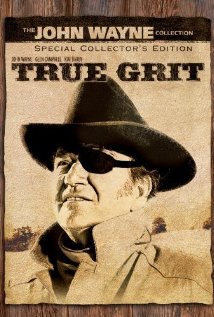
| Director(s) | Henry Hathaway |
| Producer(s) | Hal B. Wallis, Paul Nathan, Joseph H. Hazen (uncredited) |
| Featured Cast | John Wayne, Glen Campbell, Kim Darby, Robert Duvall, Dennis Hopper |
| Total Facts | 30 |
"Boeuf" means "Beef" in French.
Sally Field was also up for the part of Mattie Ross.
Henry Hathaway later said he hated Glen Campbell's performance, which he described as wooden, and claimed the singer was only cast so he could have a hit with the theme song which would help promote the film.
Sondra Locke was considered for the role of Mattie Ross. She read the script but wanted to do avoid type-casting.
Jim Burk doubled for John Wayne in the final jumping fence stunt at the end.
John Wayne actively campaigned for the role of Rooster Cogburn after reading the novel.
John Wayne did not get along with Robert Duvall during filming, and at one point threatened to punch the young Method actor if he argued with the director again.
John Wayne had initially promised the role of Mattie Ross to his daughter Aissa Wayne, but director Henry Hathaway refused to cast her.
John Wayne had met singer Karen Carpenter on a college show he hosted prior to the shooting of this movie. Wayne was so impressed that he wanted Carpenter cast in the role of Mattie Ross.
John Wayne was disappointed by the casting of Kim Darby as Mattie Ross, and the two hardly spoke at all off camera. He later said, "Christ, talk about having no chemistry with your leading lady! She was the goddamn lousiest actress I ever worked with."
John Wayne's Best Actor Oscar win was widely seen as a sentimental choice, more in recognition of his forty year career. His performance in this movie was dismissed by many critics as over-the-top and hammy.
Tuesday Weld turned down the role of Mattie.
Elvis Presley was considered for the role of La Boeuf, the Texas Ranger. However, his manager "Colonel" Tom Parker insisted that Presley should receive top billing, so the part was given to Glen Campbell instead.
Mia Farrow, among other well-known actresses, was approached to play Mattie, but she turned it down. Robert Mitchum had told her that Henry Hathaway was impossible to work with. She later said it was one of the biggest professional mistakes of her career.
True Grit's release date, of Wednesday, June 11th, 1969 was ten years before John Wayne lost his life, on Monday, June 11th, 1979.
Marguerite Roberts was a formerly blacklisted writer. John Wayne knew this before he read the script. He read it and liked it. He ignored people who said he shouldn't work on anything that a "blacklisted" writer wrote.
After judging The Carpenters on a talent show, John Wayne had Karen Carpenter read for the part of Mattie. The producers went with Kim Darby, who had acting experience; however, Wayne did not like working with her, because he felt she was unprofessional on the set.
Chimney Peak is visible in the famous shootout scene at the end. It is part of the Cimarron Range outside Ridgway, CO.
Despite the film's commercial success, John Wayne was not pleased with the finished film. He greatly disliked Kim Darby's performance, and told interviewers that he had starred in much better films like Stagecoach. At the Oscar ceremony on 9 April 1970 Wayne personally told Richard Burton that he felt he should have won the Oscar instead, for his portrayal of King Henry VIII in Anne of the Thousand Days.
Finnish censorship certificate # 77983
Rooster Cogburn wields a Winchester 1892 rifle with a looped lever and a Colt 1873 SAA revolver. Le Bouef carries a Sharps single-shot rifle. Mattie uses a Colt-Walker 1847 "Dragoon" revolver. Chaney uses a Henry rifle.
Stunt double Jim Burk performed the entire scene where Rooster Cogburn charged Ned Pepper's gang of horseback. John Wayne was only seen briefly in close up, riding a trailer.
The character of Mattie was supposed to be 14. Kim Darby was going on 22 when the film was made.
The character of Rooster Cogburn was supposed to be around forty. John Wayne was 61 when the film was made.
The gang's cave hideout (beds partially intact), snake pit, and various prop rocks can still be seen on private property outside Ouray, Colorado.
The only film for which John Wayne ever won an Oscar.
The scene near the end where Rooster Cogburn (John Wayne) and Ned Pepper's gang meet in a field and Pepper (Robert Duvall) is shot was filmed in a clearing near the top of Owl Creek Pass outside Ridgway, CO. The field is off the road to the left and is very easy to find.
This is the (uncredited) film debut of Wilford Brimley.
Wayne's eye-patch is worn over his left eye, the same eye over which his long-time director John Ford wore his.
When submitted for a rating from the MPAA in 1969, the film was given an "M". The film was edited and re-rated "G".