Facts > Films > The Sound of Music
The Sound of Music (1965) Facts
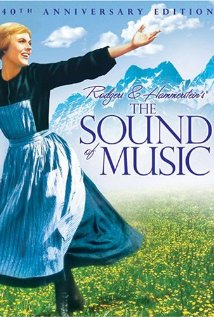
| Director(s) | Robert Wise |
| Producer(s) | Robert Wise, Richard D. Zanuck (uncredited), Saul Chaplin, Peter Levathes (uncredited) |
| Featured Cast | Julie Andrews, Christopher Plummer, Eleanor Parker, Richard Haydn, Peggy Wood |
| Total Facts | 85 |
One of only 4 productions to win both the Best Musical (or Best Play, as applicable) Tony (1960) and the Best Picture Oscar (1965). The other 3 are My Fair Lady (1957/1964), A Man For All Seasons (1962/1966) and Amadeus (1981/1984).
Originally to be directed by William Wyler, who actually scouted locations and toyed with the script. He had a different film in mind; tanks crashing through walls, etc.
Prior to 14 March 1938 Austria drove on the left-hand side of the road. This is why cars registered in Austria up until the Anschluss had right-hand drive.
Right after her talk with Maria, the Baroness is at the party talking to Max. The song the orchestra is playing is a song from the play version that was not used in the movie called "How Can Love Survive". This song was sung by the Baroness and Max. However, the tempo and rhythm of the song were altered quite dramatically, when played as a piece of orchestral music at the party in the film, hence the melody isn't immediately recognisable. The melody was stripped of the dramatic intensity and urgency that characterised it in the stage version, and was made to sound like a schmaltzy waltz.
Six burly Austrians were hired to pull the heavy car by two ropes while the actors push from behind when the von Trapps are escaping their home in Salzburg.
The actors had to be continually hosed down while filming the scene after they had fallen out of the boat, in order to remain dripping wet.
The costume that Duane Chase (Kurt) wears at the party is called a Tracht, an authentic Austrian costume. The jacket he wears is called a Loden.
The first musical number in the film, The Sound of Music, was the final sequence shot in Europe before the cast and crew returned to Los Angeles. It was filmed in late June and early July of 1964. Despite the warm and sunny appearance, Julie Andrews notes that she was freezing running up that mountain over and over again. Director Robert Wise has said that he had to climb one of the trees nearby to be able to overview the helicopter shoot without getting in the picture.
The first scene filmed was the scene in Maria's bedroom where Frau Schmidt brings the dress material, and later Liesl sneaks in through the window. One of the last scenes filmed was the "You are Sixteen" number, which appears in the film right before the scene in Maria's room. The two scenes were shot about 4 months apart.
The front and back of the Von Trapp estate were filmed at 2 different locations in Salzburg, Austria.
The gazebo changes size (becomes larger) when we go inside it. This is intentional. There was a real gazebo on the property where they filmed the scenes at the back of the house, but it was too small for the dance numbers, so they built an interior for the gazebo in Hollywood that was significantly larger.
The gazebo used for the "Sixteen Going on Seventeen" and "Something Good" scenes can still be visited in the Salzburg area, on "Sound of Music" tours. However, the public had to be excluded from the interior because film fans who were considerably older than "sixteen going on seventeen" were injuring themselves while trying to dance along the seats. The gazebo in Austria was only used for exterior shots. The actual dance by Charmian Carr and Daniel Truhitte was, in fact, filmed on a replica of the gazebo's interior on a sound stage at 20th Century-Fox in Los Angeles, as were the shots of Julie Andrews and Christopher Plummer.
The house that was used as the Von Trapp home was actually owned by actress Hedy Lamarr.
The Ländler dance that Maria and the Captain shared was not performed the traditional way it is done in Austria.
The librettists, Howard Lindsay and Russel Crouse, originally intended to use songs that the real von Trapp family had sung. However, Mary Martin, who was to be in the play, asked Richard Rodgers and Oscar Hammerstein II to write a song for her character. Due to concerns that their original song would not mix well with the folk music, Rodgers and Hammerstein suggested writing a whole new score, the music we know today.
The movie drops three songs from the original show: "How Can Love Survive" and "No Way to Stop It", which screenwriter Ernest Lehman felt were unnecessary, and "An Ordinary Couple," which was replaced by "Something Good". Ernest Lehman was of the notion that audiences would find the Baroness sympathetic if she sang, and hence her songs ("How Can Love Survive" and "No Way to Stop It") were cut, even though the songs don't necessarily evoke sympathy. "How Can Love Survive" is a duet between Elsa and Max, where the two characters reflect on how wealthy both the Baroness and the Captain are, and how difficult it is to keep romance alive amidst opulence. "No Way to Stop It" is a trio, where Elsa and Max try to convince the Captain not to oppose the Nazis, but to carry on living life as usual.
The organ passages in the film's underscore were performed by jazz organist Buddy Cole, who suffered a fatal heart attack the day after his recording sessions.
The original Broadway production of "The Sound of Music" opened at the Lunt-Fontanne Theatre on November 16, 1959, ran for 1443 performances and won (in a tie) the 1960 Tony Award for the Best Musical.
The Reverend Mother's line, "I will lift mine eyes to the hills from whence cometh my help!" is the first line of the Psalm 121, since the family was heading right into the hills, in hopes that God would send help from those hills to protect the von Trapp family.
The singing of Peggy Wood (Mother Abbess) was dubbed, as she herself declared that she was too old to handle the vocals.
The song "Edelweiss" was written for the musical and is little known in Austria. The song was the last that Oscar Hammerstein II wrote before his passing in 1960.
The songs "I Have Confidence" and "Something Good" were written especially for the film, by Richard Rodgers, the latter song replacing "An Ordinary Couple" from the stage version. The two numbers became so popular and so integrated into the musical, that most subsequent stage productions, including the 1998 Broadway Revival, have felt the need to add them on (and delete "An Ordinary Couple" in the process).
The soundtrack album of the film (RCA Victor: 1965) is one of the best-selling soundtracks of all-time (some 11 million copies sold worldwide) and has never been out of print. A Grammy nominee for Album of the Year which remained at number one on the Billboard Charts for some five weeks, the very earliest issues of the album came with an illustrated booklet discussing the making of the film and the lives and careers of composers Richard Rodgers and Oscar Hammerstein II.
The von Trapp street address is '53'. When Maria first comes to the villa and is looking through the gate, the address sign is on the stone pillar to the left.
Though the film is virtually unknown in Austria, due to the international popularity you can visit the places were the filming took place with a special tour. Furthermore in many hotels in Salzburg the movie is played non-stop on TV for the tourists.
Titles of the film in foreign countries translate to English as Smiles and Tears (Spain), The Melody of Happiness (France), "The Rebellious Novice" (Argentina and Brazil). In Croatia the movie is known under the same title as in Austria and Germany- "My Song - My Dream" ("Moje pjesme, moji snovi").
Twentieth Century-Fox bought the film rights to the musical in 1960, along with the rights to two German films about the family. The project was jeopardized by the poor box-office showing of a compilation of the German films, as well as Fox's financial difficulties resulting from Cleopatra.
Two years before the musical made its Broadway debut, Paramount bought the rights to the Von Trapp Singers story, intending to cast Audrey Hepburn as Maria. When Hepburn declined, Paramount dropped plans for a film.
Voted number 18 in channel 4's (UK) "Greatest Family Films"
When Maria is running through the courtyard to the Von Trapp house in "I Have Confidence", she trips. This was an accident; however, director Robert Wise liked this so much that he kept it in the movie. He felt it added to the nervousness of the song and of the character.
When negotiations over his film The Sand Pebbles kept breaking down, Robert Wise started looking around for another project to do while he waited for things to get sorted. The Sound of Music basically fell into his lap after William Wyler dropped out of the project. Wyler wanted the film to be more serious and make more of the Nazis in the story. 20th Century Fox didn't care for his approach.
When setting up for filming the Captain and Maria's wedding scene, there was nobody at the altar to wed them when they reached the top of the stairs. Someone had forgotten to summon the actor playing the bishop. According to Julie Andrews, the real bishop of Salzburg is seen in the movie.
When the Best Picture Oscar went to The Sound of Music (April 18, 1966), it was the first time the Academy Awards had ever been broadcast in color (ABC TV) (see also The Greatest Show on Earth).
When the film was released in South Korea, it did so much business that some theaters were showing it four and five times a day. One theater owner in Seoul tried to figure out a way to be able to show it even more often, in order to bring in more customers. So he cut out all the musical numbers.
While the von Trapp family hiked over the Alps to Switzerland in the movie, in reality they walked to the local train station and boarded the next train to Italy. From Italy, they fled to London and ultimately the USA. Salzburg is in fact only a few miles away from the Austrian-German border, and is much too far from either the Swiss or Italian borders for a family to escape by walking. Had the von Trapps hiked over the mountains, they would have ended up in Germany, near Adolf Hitler's mountain retreat.