The Red Shoes (1948) Facts
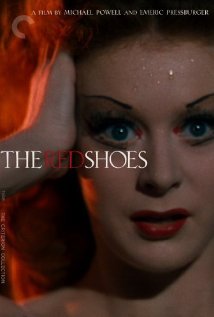
| Director(s) | Michael Powell, Emeric Pressburger |
| Producer(s) | Michael Powell, Emeric Pressburger, George R. Busby |
| Featured Cast | Esmond Knight, Irene Browne, Robert Helpmann, Albert Bassermann, Jack Carter |
| Total Facts | 26 |
Michael Powell and Emeric Pressburger collaborated again thirty years after finishing this film to produce a novelization of "The Red Shoes" in 1978. The action of the novel is set in the 1920s.
Stewart Granger first suggested that Michael Powell & Emeric Pressburger look at Moira Shearer as the leading lady.
Jack Cardiff deliberately manipulated camera speed during the Red Shoes ballet to create the effect of dancers almost hovering in mid-air at the peak of their jumps.
Emeric Pressburger originally wrote the script in 1937 when producer Alexander Korda was casting around for a project for his wife, Merle Oberon. The intention was that a professional dancer would fill in for Oberon in the dancing scenes. Nothing ever came of it - mainly due to the intervention of the war - and Michael Powell and Pressburger were able to buy the rights for the screenplay back from Korda for £12,000 in 1947. To do this, however, they had to pretend that it was purely for sentimental reasons and not because they wanted to make it into a film. Having worked for Korda before, they both knew that he was a very shrewd businessman and that, if he detected they really wanted the property, he would have raised the price.
Anton Walbrook's character of Lermontov was generally thought to be based on ballet impresario Sergei Diaghilev, the man behind Vaslav Nijinsky. Michael Powell and Emeric Pressburger, however, were more inclined to say that he was a representation of their first main mentor, Alexander Korda.
Allan Gray was dismissed as the film's composer to be replaced by Brian Easdale who won an Oscar for his work on the film.
Brian Easdale's Oscar-winning score was performed for the film by the Royal Philharmonic Orchestra and conducted by Sir Thomas Beecham.
Christopher Challis had just graduated from camera operator to director of photography having previously worked with Michael Powell, Emeric Pressburger and Jack Cardiff. However, on hearing that the three would be working together on a film about ballet, he went to them and told them that he would happily revert back to the role of camera operator just for the chance of working with them again.
Hein Heckroth's involvement as production designer marks the first time that a painter was hired to supervise the look of a motion picture.
A restored print has been made by Martin Scorsese's Film Foundation and the UCLA Film & Television Archive. Involving many years work they went right back to the original negatives, digitally repairing any scratches and misalignment. The restored print was shown at Cannes 2009 to great acclaim and will be shown theatrically as well as being made available on DVD and Blu-Ray.
Art director Hein Heckroth was a painter who had never worked as the art director on a film before. He had designed the costumes for previous Archers productions like Black Narcissus. He created a 15-minute "animatic" (filmed storyboard) reel to convey the type of mood and feel his sets would give, which acted as an ideal guide for cinematographer Jack Cardiff.
Casting the role of Vicky Page was a tough call for Michael Powell and Emeric Pressburger. Ideally they wanted a ballerina who could act and who also had to be ravishingly beautiful. They were thrilled when they discovered Moira Shearer who was second to Margot Fonteyn at the famous Sadler's Wells Ballet, but she initially rebuffed them. In the year it took to persuade her to come round, the directors were forced to consider casting actresses like Ann Todd and Hazel Court, and cheating with a real ballerina in the ballet sequences.
Cinematographer Jack Cardiff wasn't keen on doing a ballet film so he forced himself to take in as many ballet productions as he could to familiarize himself with this art form. He was soon won over.
Film debut of Moira Shearer.
Much to his surprise, Michael Powell had great difficulty persuading Moira Shearer to be in the film. She held out for a year before giving in to him. Shearer herself, however, did not particularly care for Powell. In later years, she described the making of the film as being a terrible ordeal: Powell was distant and aloof and never really gave her much direction; and having to dance for hours on end on concrete floors also physically took its toll on all the dancers, making their legs swell up.
On her first day of shooting, Moira Shearer got badly sunburned and developed a blister on her back. Later in the production she also wrenched her neck quite badly when called to leap from a window, and received a scratch that turned into an abscess. Shearer would often find herself being suspended in a harness for up to eight hours while being buffeted by wind machines.
Originally this was designed to be a vehicle for Merle Oberon. However, Michael Powell stipulated that the only condition he would make the film under was that the lead should be a dancer.
Technicolor founders Herbert T. Kalmus and Natalie Kalmus considered this film the best example of Three-Strip Technicolor. During the filming, however, Natalie Kalmus often complained that Jack Cardiff wasn't following the rules laid down for Technicolor films and demanded that they re-shoot various scenes. But Michael Powell always backed up Cardiff and they got the film they wanted.
The 15-minute (approximately) "Ballet of the Red Shoes" used a corps de ballet of 53 dancers.
The exterior of The Mercury Theatre, Notting Hill Gate was shown in the rain because Michael Powell had often gone there to see plays or the ballet and he reminisced "it always seemed to be raining when one queued up for Madame Rambert's productions".
The film went massively over budget and the Rank Company (which financed it and was to release it) had little faith in its commercial potential. It tried to bury the film by not giving it a premiere (backer J. Arthur Rank walked out of its first performance) and by just letting it quietly show at late screenings at a cinema in London. Rank wasn't even prepared to strike a print for the American market. Slowly, however, audiences started to pick up on the film and Rank realized that it might have a potential breakout hit after all. Indeed, when an initial print was made for the US, it played at an off-Broadway theater for an unprecedented 110 weeks. That was enough to convince Universal to take up the distribution rights for the US, which it did in 1951.
The title ballet sequence took six weeks to shoot and employed over 120 paintings by Hein Heckroth. The dancing newspaper was achieved through careful cutting and use of wires.
There is a frequent complaint that comes up by viewers as to why, in the final sequence, Vicky is wearing the red ballet shoes *backstage* when the story and ballet opens with her in a different pair of shoes. Vicky's dresser is clearly seen carrying the white/pale pink shoes that she wears in the beginning and is ready to give them to Vicky to change into, when she has her final 'impulse' to run out to the balcony. (She was probably just checking, or breaking in, the shoes in the first place, but the symbolism of the red shoes controlling her life wouldn't translate if she wasn't seen wearing them.)
This film is #9 in the "BFI 100", a list of 100 of "the best British films ever" compiled by the British Film Institute in 1999/2000.
When Ludovic Kennedy saw Moira Shearer in this film, he said that he knew instantly that she was going to be the girl he would marry. He actively sought her out and married her two years later, in February 1950 in the Chapel Royal in London's Hampton Court Palace.
When people complained to Hein Heckroth about the grim ending, he pointed out to them that in Hans Christian Andersen's original fairy tale, the ballerina had her feet hacked off by a woodsman to stop her dancing.