Facts > Films > The Maltese Falcon
The Maltese Falcon (1941) Facts
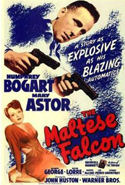
| Director(s) | John Huston |
| Producer(s) | Hal B. Wallis, Henry Blanke |
| Featured Cast | Humphrey Bogart, Mary Astor, Gladys George, Peter Lorre, Barton MacLane |
| Total Facts | 68 |
'Elisha Cook Jr' was the longest surviving member of the cast, dying at the age of 90 in 1991.
"Academy Award Theater" broadcast a 30 minute radio adaptation of the movie on July 3, 1946 with Humphrey Bogart, Sydney Greenstreet and Mary Astor reprising their film roles.
"The Screen Guild Theater" broadcast a 30 minute radio adaptation of the movie on May 18, 1950 with Humphrey Bogart reprising his film role with his wife Lauren Bacall who was not in the original film.
"The Screen Guild Theater" broadcast a 30 minute radio adaptation of the movie on September 20, 1943 with Humphrey Bogart, Mary Astor, Sydney Greenstreet and Peter Lorre reprising their film roles.
"The stuff that dreams are made of" was voted as the #14 movie quote by the American Film Institute. The line is paraphrased from William Shakespeare's "The Tempest": "We are such stuff as dream are made on, / And our little life is rounded with a sleep."
Humphrey Bogart and Mary Astor's dialog-heavy final scene took 3 days to shoot.
Humphrey Bogart had to supply his own wardrobe. This was common practice at Warner Brothers as a way for the studio to save some money.
Humphrey Bogart has absolutely no resemblance to the character of Sam Spade as described in the book. There, he is over 6 feet tall, has a hooked nose and blond hair.
Jerome Cowan, playing Spade's doomed partner Miles Archer, is only on-screen for two minutes total, although to many it seemed as if he had a much bigger part.
George Raft was originally cast as Sam Spade. He turned it down because it was "not an important picture," taking advantage of a clause in his contract that said he did not have to work on remakes.
However, according to the author John McCarty, author of The Films of John Huston, in an ICONS Radio interview (10-07-07) the real reason Raft bowed out was because a successful screenwriter, John Huston, was going to direct his first movie. Raft didn't want to trust his part to this neophyte director.
John Huston had Mary Astor run around the set several times before each of her scenes in order to give her a breathless, nervous appearance on screen.
John Huston hated the first two attempts to film "The Maltese Falcon". He felt particularly strongly about the fact that the studio had imposed a happy ending on the previous two examples.
John Huston planned every part of the film down to the very last detail, storyboarding all of it. His notes on the script were so efficient that not one line of dialog was changed in the final edit.
John Huston recruited Mary Astor to play a prank on his father, Walter, after the elder Huston had filmed his cameo. Astor called up Walter, telling him she was producer Hal Wallis' secretary, and that Wallis thought he'd over-acted during his scene. Huston was enraged, declaring that he'd never been accused of over-acting in his life, but agreed to return the next day to re-shoot the scene. John then took the phone from Astor, identified himself as Wallis, and repeated the criticism. Walter grew even more furious, declaring that he'd already agreed to the re-shoot, and it was only when John exploded in laughter on the other end of the phone that Walter realized his son was playing a prank on him.
John Huston's first directorial effort.
Peter Lorre's favorite of his films.
Sydney Greenstreet appeared in a special trailer to promote the film.
Sydney Greenstreet was cast whenever the production had difficulty finding an actor large enough.
Sydney Greenstreet's first on-screen appearance.
Mary Astor was having an affair with John Huston during the making of the film.
Mary Astor's off-screen notoriety was instrumental in her casting. She was known for being adulterous, having had an affair with John Barrymore, widowed in a plane crash, a multiple bride, and an alcoholic. She also kept a diary of her various sexual exploits that was introduced as evidence in a custody hearing against her estranged husband over who should look after their daughter. The gossip rags thrived on this story.
Walter Huston did his uncredited cameo as a good luck gesture for his son. He had to promise to the notoriously tight head of studio, Jack L. Warner, that he wouldn't charge for his appearance.
Walter Huston: Capt. Jacobi.
A copy of John Huston's first draft script was accidentally sent to studio head Jack L. Warner as well as the film's designated producer, Henry Blanke. To his surprise, Warner loved the script and insisted that Huston started shooting it immediately.
According to Mary Astor in her autobiography 'A Life on Film', Sydney Greenstreet was very nervous before his first scene and remarked," Mary dear, hold my hand, tell me I won't make an ass of meself!"
After Geraldine Fitzgerald had made it clear that she wasn't interested in doing the film, the next port of call for the part of Brigid O'Shaughnessy was Mary Astor. John Huston and Humphrey Bogart visited her at her home to talk over the script and she was immediately smitten by their palpable excitement in the project. Already familiar with the novel, Astor was even more impressed with the screenplay which she thought was a "humdinger". She signed on straight away.
Although he story-boarded every scene, John Huston was open to abandoning his plans if his more-experienced cast came up with something better. He estimated that three-quarters of the time, he used his original set-ups, but for the remaining quarter, he adopted ideas that the cast had come up with during rehearsal.
Although this was the 62-year old Sydney Greenstreet's film debut, he had already worked as a prominent stage actor for forty years.
As a joke, Walter Huston kept fumbling his walk-on cameo so his son John had to do lots of different takes.
At 357 pounds, 60-year-old British newcomer Sydney Greenstreet was so large that the studio had to specially manufacture his entire wardrobe for the role of Kasper Gutman.
Contrary to popular opinion, "It's the stuff that dreams are made of", spoken by Humphrey Bogart, is not the last line in the picture. Immediately after Bogart says that, Ward Bond, playing a detective, says, "Huh?" making that the last line in the picture.
Filming was completed in two months at a cost of less than $300,000.
For decades, this film could not be legally shown on US TV because of its underlying sexual suggestion.
From the start, Peter Lorre was always John Huston's first choice to play Joel Cairo.
Frustrated at seeing his script for Juarez rewritten by Paul Muni, the film's star, John Huston vowed that from then on he would direct his own screenplays and therefore not have to see them get meddled with. He was fortunate in that he had a staunch ally in the form of producer Henry Blanke who was happy to fulfill Huston's wish.
Gutman and Wilmer are referred to as "Fat Man" and "Little Boy". These are the names used for the two atomic bombs dropped on Nagasaki and Hiroshima respectively.
Having seen how profligate novice writer-directors like Orson Welles and Preston Sturges had been, Warner Brothers were not keen on giving John Huston too much control. They acquiesced when Huston agreed to do an immediate polish on the script for Sergeant York.
In 2007, the American Film Institute ranked this as the #31 Greatest Movie of All Time.
In all the scenes involving Mary Astor, there's a suggestion of prison. In one scene, she wears striped pyjamas, the furniture in the room is striped and the slivers of light coming through the Venetian blinds suggest jailcell bars. When she steps into the elevator at the end of the film, the lighting also suggests bars.
In real life, Dashiell Hammett had been a one-time operative for Pinkerton's Detective Agency. Brigid O'Shaughnessy was partly based on his secretary, Peggy O'Toole, and partly on a woman who once employed him to fire her housekeeper. Joel Cairo was based on a man Hammett picked up on a forgery charge in 1920, while Wilmer, the gunman, was drawn from a petty criminal who went by the nickname of "The Midget Bandit".
It was Howard Hawks who knew that John Huston wanted to direct. He suggested that Huston do The Maltese Falcon which was already owned by Warner Brothers and had been adapted to film twice before. Unlike the previous productions, Hawks suggested that Huston "film the book." Before going on a vacation, John Huston gave his secretary a copy of the book and told her to type it up in screenplay form. Studio chief Jack L. Warner saw the script, read it, and gave it a green light even before John Huston has a chance to read it.
Kasper Gutman's (Sydney Greenstreet) repeated phrase of "By gad, sir..." was originally written to be "By God;" however, the script underwent changes when it clashed with the censors.
Most of the film was shot sequentially.
Much of the movie is filmed over Humphrey Bogart's shoulder so that the audience can be in on his point of view.
One of the first films admitted to the National Film Registry in its inaugural year, 1989.
Ranked #6 on the American Film Institute's list of the 10 greatest films in the genre "Mystery" in June 2008.
Sam Spade refers to Wilmer as a "gunsel", a term the censors assumed was a slang reference to a gunman. The Yiddish term "gunsel", literally "little goose", *may* be a vulgarism for homosexual (the word "faigle", or "little bird", is usually used in that manner). It is more usually an "underground" term which refers to a person who is either a "fall guy" or a "stool pigeon", in which case Spade is making both a direct and an indirect reference to Wilmer's character.
The "Maltese Falcon" itself is said to have been inspired by the "Kniphausen Hawk," a ceremonial pouring vessel made in 1697 for George William von Kniphausen, Count of the Holy Roman Empire. It is modeled after a hawk perched on a rock and is encrusted with red garnets, amethysts, emeralds and blue sapphires. The vessel is currently owned by the Duke of Devonshire and is part of the Chatsworth collection.
The William Shakespeare reference that ends the film was suggested by Humphrey Bogart.
The climactic confrontation scene lasts nearly twenty minutes, one-fifth of the entire running time of the film. It involves all five principal characters, and filming required over one full week (one day - 4 July 1941 - was taken off).