Facts > Films > The Guns of Navarone
The Guns of Navarone (1961) Facts
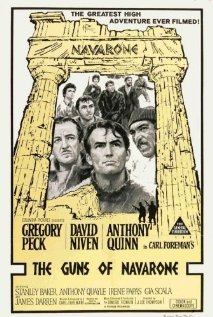
| Director(s) | J. Lee Thompson, Alexander Mackendrick (uncredited) |
| Producer(s) | Carl Foreman, Cecil F. Ford, Leon Becker |
| Featured Cast | Gregory Peck, David Niven, Anthony Quinn, Stanley Baker, Anthony Quayle |
| Total Facts | 41 |
"Yialo Yialo" ("Seashore, Seashore"), heard sung at a wedding celebration, is a Greek folk song about love and the sea. As with many provincial folk songs, verses are often improvised as it's sung. The first verse heard in the film (asking the sea not to wake the singer's beloved) is standard, while the second verse, sung by actor/singer James Darren, is ostensibly improvised. The verse asks the mountains to bow down so that he can see his dearest love, "Anoula", and far-away home, "Rahoula". This improvisation came about as follows. Carl Foreman's production coordinator with the Greek government, Daniel Bourla, who also functioned as the producer of two shorts made on the filming of Guns of Navarone - one directed by 'John Schlesinger' and one by Bourla - tried to obtain an affidavit from the Greek government certifying that Yalo Yalo was in public domain. The certification was issued but it erroneously listed Bourla as its author. Whereupon, Bourla issued a release himself for the use of this song and added a needed additional verse to the song using the name Anoula (Anna being his girlfriend at the time).
Gregory Peck declined to attempt an English accent in order to play Captain Mallory.
Gregory Peck often said he was disappointed that so many viewers had missed how anti-war the film was intended to be.
Gregory Peck revealed, in a later interview, his bemusement at co-star Anthony Quinn's decision to wear a red undershirt, which was only somewhat revealed through most of the film, but which became a glaring focal point when wet and placed against a most blue and gray background near the end of the movie.
Dean Martin and Alec Guinness were considered for David Niven's role.
Rock Hudson was considered for Gregory Peck's role. Cary Grant was also briefly considered, but was rejected as being too old at 56.
William Holden asked for $750,000 plus 10% of the gross to play Mallory. He was turned down and Gregory Peck was cast.
Anthony Quinn was always Carl Foreman's first choice to play Stavros.
Stanley Baker's character, Pvt. Brown is referred to as "The Butcher of Barcelona" by Capt Mallory, as a reference to his service with the Republican forces in the Spanish Civil War. In the 1930s, Carl Foreman, the producer and screenwriter of the film, had been a member of the Communist Party, many of whose members fought for the Republic during the Civil War. Foreman was blacklisted during the early 1950s and moved to England, where he continued to work in the film industry. During the period of the blacklist, left-wing supporters of the Spanish Republic often were denounced for being "premature anti-fascists" for having fought against Franco, Hitler and Mussolini before the U.S. went to war against the Axis two years after the collapse of the Spanish Republic.
Kenneth More was originally cast as Miller but was released from the film (and his contract at Rank) after abusing and swearing at Rank chief John Davis during a BAFTA dinner at the Dorchester. He was replaced by David Niven.
Anthony Quayle spent part of WWII in Albania organizing guerilla forces.
J. Lee Thompson's handling of intimate drama on Tiger Bay and of large scale action setpieces on North West Frontier landed him the director gig.
James Darren was cast as Private Spyros Pappadimos in hopes it would get him out of the "teen idol" stage. However, the sequel to 'Gidget' came out later in the year, starring James Darren as Moondoggie.
James Darren was concurrently on honeymoon during filming.
David Niven initially felt that he was badly miscast in the offbeat role of a corporal, but later said he considered it to be one of his best performances despite being too old for the part.
David Niven wears a Light Infantry cap badge on his beret. This was the regiment he was commissioned into in WW2.
80s rock group Big Country borrowed from Dimitri Tiomkin's score to create the guitar riff on their hit "Fields of Fire".
According to the 50th anniversary book about the RAF's Battle of Britain Memorial Flight the Flight's Lancaster appeared in the film.
Actor Michael Trubshawe (Weaver) was David Niven's oldest friend. The two men served in the military together as young men, and Niven was later responsible for persuading Trubshawe to pursue an acting career. Niven also made it an inside joke to try to mention Trubshawe's name in as many of his own films as he could, usually as a reference to some unseen character.
Andreas's revolver that he points at Mallory from behind the newspaper is an Enfield No 2 Mk I* (identifiable as the "*" modification by the lack of the hammer spur). It fired the anemic .380/200 service round and is widely considered to be one of the worst service sidearms ever foisted on an unwilling army.
Because the stars were all too old for their characters, the movie was nicknamed "Elderly Gang Goes Off to War" by the British press.
Despite the narrated prologue (see Memorable Quotes) setting the "historical background", this is a work of fiction. There was no such mission, because there never were any guns of Navarone.
Director J. Lee Thompson's first American feature was also his opportunity of working with some of the biggest Hollywood stars.
During WWII, 'David Niven' commanded units in both the Commandos and the GHQ Liaison Regiment, a special reconnaissance unit that operated behind enemy lines.
For the scene where the commandos scale the near-vertical cliff, the rockface was a painted backdrop laid out on the ground, so the actors were actually climbing over the studio floor and then the image was tilted in camera.
One of the Rhodian locations used in the film has been renamed "Anthony Quinn Bay" after the actor was reported to have bought property nearby.
Original director was Alexander Mackendrick, but he was fired by Carl Foreman due to "creative differences".
Producer Carl Foreman brokered a deal with the Greek army where he had 12 destroyers and over 1000 infantrymen at his disposal.
Some members of the Greek royal family and their entourage were extras in the café scene as they were visiting the set on the day that scene was being filmed.
The $50,000 fee paid to composer Dimitri Tiomkin was the highest fee paid to a composer for a single feature film score up to that time.
The only time David Niven ever smoked cigarettes on screen.
The original 1961 road show release used Technicolor prints made in London, which gave the film eye-popping clarity and disguised many of the imperfections of the sets and special effects. When it came time to turn out mass runs of prints for the general release, Columbia shipped the original negative to a bargain-rate lab in New York, where it was reconfigured for normal Eastmancolor printing. This meant re-cutting the negative to insert standard opticals to approximate the Technicolor process's smooth dissolves, etc. No preservation separations were made and the negative wasn't properly protected. Poor-quality dupe sections were soon patched in to replace damaged pieces of the negative. Eventually two entire reels would have to be replaced in this way, after that New York lab accidentally destroyed the originals through handling errors. Columbia also discarded the film's original sound elements and stereo tracks. A collector's magnetic print was used to recover the original four channel stereo mix.
The plot went through so many twists that Gregory Peck finally submitted his own version to Carl Foreman: "David Niven really loves Anthony Quayle and Gregory Peck loves Anthony Quinn. Tony Quayle breaks a leg and is sent off to hospital. Tony Quinn falls in love with Irene Papas, and Niven and Peck catch each other on the rebound and live happily ever after."
The screenplay differs drastically from Alistair MacLean's book in terms of characters, including the identity of the traitor and the two women who don't even appear in the novel.
The top grossing film of 1961.
There had been some concern that the cast would not get along, particularly since Anthony Quinn had a reputation for being difficult to work with. However, in the event things went smoothly, although according to Quinn Stanley Baker did not get along with the others. Some of the cast believed that Baker felt he should have been playing Mallory.
There is no Navarone in real life.
There was reportedly much tension between many of the stars (particularly Gregory Peck and Anthony Quinn) early in the film's production, but the cast gradually bonded over endless games of chess.
There was some surprise that Stanley Baker, who in 1960 was considered the most popular British movie star, accepted the relatively small supporting role of Private "Butcher" Brown. Baker revealed that he wanted to be in the movie because he was impressed at how anti-war the screenplay by the blacklisted writer Carl Foreman was.
When Mallory says of Stavros: "He's from Crete; those people don't make idle threats", he's inverting the famous quote by the Cretan philosopher Epimenides, that "all Cretans are liars". The end of the movie reveals which of the two is right.
With a budget of $6 million, at the time, this was one of the most expensive films ever made.