Facts > Films > The Caine Mutiny
The Caine Mutiny (1954) Facts
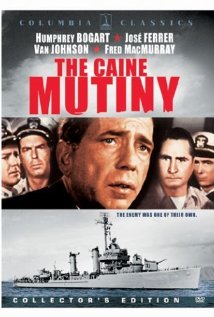
| Director(s) | Edward Dmytryk |
| Producer(s) | Stanley Kramer (uncredited) |
| Featured Cast | Humphrey Bogart, José Ferrer, Van Johnson, Fred MacMurray, Tom Tully |
| Total Facts | 32 |
"The Caine Mutiny Court-Martial" opened at the Plymouth Theater on January 20, 1954, and ran for 415 performances starring Henry Fonda and Lloyd Nolan.
Humphrey Bogart's tour-de-force performance in the climactic courtroom scene was so powerful that it completely captivated the onlooking film technicians and crewmen. After the scene's completion, the company gave Bogart a round of thunderous applause.
Richard Widmark was chosen for the lead role, but producer Stanley Kramer wanted Humphrey Bogart.
Stanley Kramer gave Fred MacMurray a prominent role in this movie during a difficult period in the actor's life - his wife had just died - and work was a needed distraction for him.
Lee Marvin, who served in the United States Marine Corps and knew a great deal about ships at sea, served double duty by also lending his expertise on military matters.
José Ferrer's role as the defense attorney was played on stage by Henry Fonda. Ferrer would later play defense attorney Abe Fortas to Fonda as Clarence Earl Gideon in Gideon's Trumpet.
Actress May Wynn (real name: Donna Lee Hickey) adopted the name of her character in this movie, May Wynn, as her stage name, and made eight more films under that name. In the novel, May Wynn is itself a stage name.
Additional (and uncredited) dialog was provided by blacklisted writer Michael Blankfort.
An October 1952 New York Times item revealed that there were two scripts prepared for Stanley Kramer, one that included "Willie" and "May's" romance and another, shorter version that only included action on the Caine and the court-martial.
Columbia Pictures was determined to hire Humphrey Bogart for the top role of Capt. Queeg, and Bogart was enthusiastic about playing it, but the Columbia brass did not want to pay him his top salary. Bogart was rather miffed at this, complaining to wife Lauren Bacall, "This never happens to Gary Cooper, or Cary Grant or Clark Gable, but always to me." Bogart correctly figured that Harry Cohn and company knew that Bogart wanted to play the part so fervently that he would agree to take less money rather than surrender the part to someone else.
Despite the accolades and impressive box-office receipts, director Edward Dmytryk felt that the film could have been even better. In "Stanley Kramer: Filmmaker" by Donald Spoto, Dmytryk said, "...it's a disappointment in my career, to tell the truth. I insist it could have been a classic ... but Kramer, who (with Dore Schary) is the most publicity-conscious man in the industry, got high-handed with Harry Cohn, and in fact had to toe the line ... Stanley Roberts' original script was about 190 pages, even without the romantic subplot ... It should have remained that - a three and one-half or four-hour picture - and it would have been more logically developed, the characters would have been further fleshed out. It would have been perfect."
Director Edward Dmytryk noted in his autobiography that Wouk's initial contribution to the script was "a disaster" and that Stanley Roberts then took over the rewrite; Wouk is only credited on screen as the author of the novel on which the film is based. Dmytryk also stated that he was unaware of studio head Harry Cohn's strict insistence that Columbia films run no longer than 2 hours and indicated that Roberts quit over the stipulated cuts required to bring the screenplay down to fit the time requirement. The final screenplay was trimmed by nearly fifty pages by writer Michael Blankfort, who is credited on screen with "additional dialog."
In the novel the Caine is a WWI vintage "flush deck" destroyer with 4 smokestacks. Since ships of this type were very scarce after WWII, the producers used a more modern WWII vintage ship.
Most of the Hollywood studios wouldn't touch Herman Wouk's best-seller because they knew that the only way they could make the film would be with the full cooperation of the Department of Defense, which would insist on making sweeping changes to the film (the DOD was openly critical of Wouk's depiction of the Navy). Undeterred, independent producer Stanley Kramer optioned the novel for $60,000. Once the novel won the Pulitzer Prize, the DOD had to soften its attitude towards the novel, given its huge popularity. It eventually approved Kramer's submitted screenplay treatment in 1952.
One of 1954's biggest money makers, second only to White Christmas, which featured José Ferrer's wife, Rosemary Clooney.
One of the biggest hits in Columbia's history, raking up a box office gross of $8.7 million in its first run.
Preparations for filming took 15 months. The length of time it took to make the film, unusually long at the time, was due in part to the unwillingness of the US Navy to endorse the film. Without the Navy's endorsement, it would have been impossible for the filmmakers to use naval equipment and personnel. The Navy was concerned that the film's subject dealt with a mutiny, and that audience would feel that it was a true story. But the filmmakers reached a compromise upon agreeing to include the comment in the opening titles that there has never been a mutiny on a US Navy vessel.
Producer Stanley Kramer and director Edward Dmytryk cast Lee Marvin as one of the USS Caine's supporting sailors, not only for his knowledge of ships at sea but for his acting talent. Throughout the production, Marvin served as an unofficial technical advisor to the filmmakers. Sometimes a shot would be set up, only to be criticized by Marvin as being inauthentic.
The abortive visit to Adm. William F. Halsey was filmed on the USS Kearsarge (CV 33) which, at the time, had been decommissioned for extensive modernization work.
The fact that the right hand of José Ferrer's character, attorney Barney Greenwald, is bandaged throughout his appearance in the film, is neither noted nor explained. In the novel, it's because he injured it flying as a Navy pilot.
The following is engraved on a plaque in the officers' wardroom. The lines on the plaque are centered: U.S.S. CAINE DMS 18 / This ship is named for / Arthur Wingate Caine / Commander U.S. Navy / who died of wounds received / in running gun battle / between submarine and / vessel he commanded, / U.S.S. Jones. / The submarine was sunk in / the engagement.
The scars on Van Johnson's face in this film are real, not makeup. While filming A Guy Named Joe, Johnson was in an automobile accident and thrown through the car's windshield. The plastic surgery of the day could not totally remove his scars. In all his later films he wore heavy makeup to hide them but felt that, in this film, they added to his character's appearance.
The typhoon referenced in the film and court martial was an actual typhoon known as "Typhoon Cobra," which struck Adm. William F. Halsey's Task Force 38 on 17 December 1944. As correctly stated in the film the actual storm did result in the sinking of three ships - the destroyers Spence, Hull and Monaghan.
The USS Caine was played by the Navy destroyer-minesweeper USS Thompson.
There was considerable opposition to the casting of Humphrey Bogart, since he was much older than Captain Queeg was supposed to be. In addition, Bogart was already seriously ill with espohagal cancer, although it would not be diagnosed until January 1956.
This film gave aspiring actor (and Humphrey Bogart fan) Maurice Micklewhite the inspiration for his screen name, Michael Caine.
This marked a spectacular comeback for director Edward Dmytryk, formerly one of the "Hollywood Ten" who had been jailed for contempt of Congress and for lying under oath while being investigated by the House Un-American Activities Committee because of his former membership in the American Communist party. Such was the effectiveness of the film that Dmytryk even received a DGA nomination.
This movie's opening prologue states: "There has never been a mutiny in a ship of the United States Navy. The truths of this film lie not in its incidents but in the way a few men meet the crisis of their lives. The time - World War II . . . "
To capture the excitement of the typhoon scene, the filmmakers originally intended to steer the ship (a replica of the USS Caine) into an actual gale for the bad-weather footage. It was eventually decided that the typhoon would be artificially created in a studio by special effects technician Lawrence W. Butler.
When Humphrey Bogart broke bread into small pieces to symbolize the deteriorating state of Queeg's mental condition, a military advisor on the set told him that no naval officer would eat bread that way.
When Ens. Willis Seward Keith went away with May to Yosemite, they witnessed the famous Fire Fall. At 9:00 each evening in Camp Curry, the crowd which had gathered for the nightly campfire program, would fall silent. A man would call out to the top of Glacier Point "Let the Fire Fall!", and a faint reply could be heard from the top of the mountain. Then a great bonfire of red fir bark would be pushed evenly over the edge of the cliff, appearing to the onlookers below as a glowing waterfall of sparks and fire. In 1968 the Park Service Director decided that the Firefall tradition should come to an end. He reasoned that since it was just a man-made attraction, and one which caused a great deal of congestion in the park, as well as damage to the meadows from the trampling of onlookers, that it wasn't worth continuing. He went as far as to point out that it caused the unnatural and unnecessary removal of red-fir bark from the park grounds.
While there never was a "Caine" in the US Navy, there WAS a DMS-18 (the hull number of the Caine). It was the Hamilton, converted from a destroyer in 1942.