The Alamo (1960) Facts
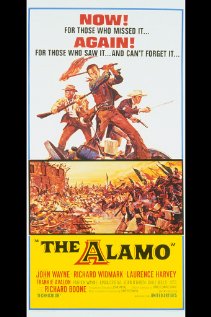
| Director(s) | John Wayne |
| Producer(s) | John Wayne, Michael Wayne (uncredited), James Edward Grant |
| Featured Cast | John Wayne, Richard Widmark, Laurence Harvey, Frankie Avalon, Patrick Wayne |
| Total Facts | 37 |
Chill Wills' aggressive campaign to win the Best Supporting Actor Oscar was generally thought to bring about a backlash, most people regarding his Variety ad in which the film's cast were praying harder for Wills to win the Oscar than the defenders of the Alamo themselves prayed on the night before the battle as a display of poor judgment. Wayne himself was appalled by the tastelessness of the ad and was forced to take out an ad himself, countering it.
Sonny Tufts was at one point considered for the role of Jim Bowie, and Clark Gable for the role of William Travis.
Charlton Heston was among the actors who were sent the script and John Wayne wanted him to play Jim Bowie. Heston later said there seemed good reasons for him not to do the film and, when pressed further, stated having John Wayne as director to be one of them.
Charlton Heston, then a moderate Democrat, turned down the role of Jim Bowie because he feared the critical response to the movie. However, later in life Heston turned around and wholeheartedly embraced right-wing Republican politics, also changing his mind about not accepting the part and saying that it was "a huge mistake".
John Wayne and Richard Widmark famously did not get along during filming. Since Widmark was a liberal Democrat who opposed blacklisting and supported the civil-rights movement and gun control - positions diametrically opposed to Wayne's - it was long rumored that politics had been the cause of the problem. However, Widmark later cited Wayne's lack of directing skills as the reason for the feud. This was something Ken Curtis agreed with, since he remarked that Wayne had no ability to motivate an actor for a scene.
John Wayne formed a close friendship with Laurence Harvey during filming. He later said Harvey should have received an Oscar nomination instead of Chill Wills.
John Wayne intended this film to be an allegory for America's Cold War with the Soviet Union.
John Wayne originally intended that Richard Widmark should play Davy Crockett, while Wayne himself would have taken the small role of Sam Houston so he could focus his energy on directing the picture. However, Wayne was only able to get financial backing if he played one of the main parts, so he decided to play Crockett and cast Widmark as Jim Bowie.
John Wayne partially financed this film himself. During shooting, the film was delayed due to various production problems. Wayne was under so much pressure, he smoked cigarettes almost non-stop when not acting.
John Wayne was a fan of The Kingston Trio's recording of "Remember the Alamo", composed by Jane Bowers, and wanted to use the song in the film. When, for various reasons, the rights to the song couldn't be obtained, Dimitri Tiomkin, who scored the film, and Paul Francis Webster wrote their own song for the film, "The Green Leaves of Summer".
John Wayne, in good fellowship, would reportedly refer to Richard Widmark by the nickname "Dick" when filming began, to which Widmark icily replied "It's Richard." After this, Wayne constantly and sarcastically emphasized Widmark's formal first name on the set, as in "Oh, RICHARD, are you ready for the next take, RICHARD?"
Richard Boone showed up on the first day of filming, sporting a full beard. It was then pointed out his character General Houston didn't actually have a beard.
Clark Gable was offered the role of Davy Crockett but turned it down. Though Gable was a Republican who shared Wayne's anti-communist views, he did not want to commit to an expensive project with a first-time director.
Sammy Davis Jr. managed to obtain a copy of the script and asked John Wayne if he could play the straight role of a Negro slave. Wayne considered him but eventually declined Davis' offer. Davis recalled, "There were a lot of influential Texans investing in the film and they didn't like the idea that I was seeing his future wife May Britt at the time. They disapproved of a man of color going out with a girl who was white, though Duke Wayne was upfront with me about it and I respected him for it".
Dimitri Tiomkin's soundtrack for the film has been in continuous print for nearly 50 years.
LeJean Eldridge was murdered during filming by her boyfriend.
At the start of production on location just a few miles from the historic battlesite, Wayne had a clergyman say a prayer for the movie in front of the assembled cast and crew of 342, asking God to bless their work and help them produce a fitting testament to the brave men who died for the cause.
Banned in Mexico.
Both Clark Gable and Charlton Heston, the two actors John Wayne wanted most to do the film, both expressed regret at not taking the parts they were offered. Heston declined the role of 'Bowie' out of political ideology (a political view he later later vehemently rejected), and Gable passed due to to the age difference between himself and William Travis. Gable's family later said that he wanted to do the film as a way to do "a macho film" to escape the typecasting of Gone with the Wind as a romantic lead.
Despite being a top-ten money maker for 1960, and its popularity in Europe and Japan, the film could not recoup its massive budget in its initial release. John Wayne assumed huge personal debt to get the film finished after United Artists refused to pay for cost overruns during production. It wasn't until the television rights sale in 1971 that Wayne's personal debts were finally paid off. It premiered on the U.S. network NBC in September 1971.
Director John Ford showed up on the set, and let John Wayne know that he wanted to direct some of the picture. Wayne sent him out with a small crew to do some second-unit work, mostly of Mexican cavalry riding through the countryside as they approached the Alamo, and Frankie Avalon estimated that the footage filmed by Ford made up approximately 10%-15% of the finished film. Other sources, however, have said that Wayne eventually deemed most of Ford's footage unusable, and little if any of it made it into the final cut of the film. According to these sources, the footage that Ford believed he shot of the Mexican cavalry patrolling the countryside was actually re-shot by a second-unit director, although Wayne didn't have the heart to tell Ford.
During the battle sequence, one of the cannons rolled over the foot of Laurence Harvey, breaking it at the instep. He continued with the scene, eventually treating the injury himself.
In the mid 1990s, a private Canadian film collector discovered what was believed to be the last surviving print of the 70mm premiere version in pristine condition. MGM used the print to make a digital video transfer of the roadshow version for VHS and LaserDisc but unfortunately stored it improperly in an archive where it dramatically deteriorated.
Lieutenant Finn's fall from his horse was unscripted and unintentional.
Originally to save on expenses, Wayne planned to shoot the film in Mexico. The Daughters of the Republic of Texas (the custodians of the real Alamo) sent him a letter that if he pursued with that course of action that he had better not show the film in Texas. Consequently Wayne found an amenable landowner, Happy Shahan, who allowed the production to film on his 20,000 acre ranch in Bracketville, Texas. When Wayne asked to meet the builder, he was introduced to a Mexican immigrant. A rather dubious Wayne asked him "Do you think you can build the Alamo?" to which the Mexican replied "Do you think you can make a picture, Mr Wayne?"
Shot over a period of 83 days.
The Alamo Village set near Brackettville was built "180 degrees out" from the actual Alamo layout in San Antonio. In other words, the facade of the chapel faces West in San Antonio, but it faces East in Alamo Village. When an Alamo Village employee was asked why this was done, he replied that, since there were several scenes set at dawn, director Wayne did not want to set up and shoot those scenes at dawn, but rather at sundown, which would be easier on the crew, and the audience would not know. He also said that Wayne thought that a small hill, located to the West of the Alamo Village set, would look good as a backdrop to some of the shots of the chapel. No such hill exists East of San Antonio.
The climactic battle scenes involved 7,000 extras, 1,500 horses and 400 Texan longhorn cattle.
The film was given a tenth anniversary re-release in 1970, one year before being shown on television for the first time.
The film's first telecast was in two separate parts on two successive nights, since the normal running time of a network broadcast of a feature film was usually limited to two hours. Few films running three hours or more were telecast in one evening at that time. However, the longest uncut telecast of a film up to that time, the 1959 "Ben-Hur", was first presented in 1971, the same year that "The Alamo" was first shown on TV, and ran five full hours because of commercial breaks.
The gun carried by Bowie was a Nock Volley Gun. It was developed for the English Navy, the idea being to fire all seven barrels at once to sweep the decks of opposing ships or destroy rigging. It was an unsuccessful design as the recoil from all seven barrels going off at once was too powerful for one man.
The huge Alamo set took two years to construct.
The original blueprints of the Alamo were used to recreate the replica building.
The set - now called Alamo Village - has since been used in over 100 other Westerns.
The set in which the film was made, now called "Alamo Village" is opened to the public in Bracketville, Texas, where there are shows, shops, and most of the buildings (including the Alamo Fort) are opened to the public daily.
The Ybarra set was later used in several films and each made additions. By 1985, however, the set was mostly in ruins, and much of it was pulled down. Using plans and period drawings, the set was rebuilt for Alamo: The Price of Freedom on its old foundations, this time to full scale under Production Designer/Art Director Roger Ragland. The new set is still in use. Both Lonesome Dove and Bad Girls have used the historically correct facade.
Wayne lobbied hard for Republic studios to fund a big budget Western. Republic, who dealt with low-budget B-movies, turned him down so Wayne was forced to finance much of the film himself. He took out a second mortgage on his homes and secured loans on his cars and yacht.