Facts > Films > Shadow of a Doubt
Shadow of a Doubt (1943) Facts
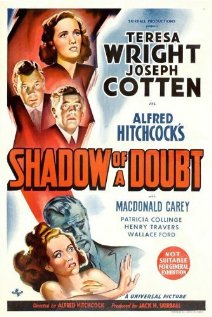
| Director(s) | Alfred Hitchcock |
| Producer(s) | Jack H. Skirball |
| Featured Cast | Teresa Wright, Joseph Cotten, Macdonald Carey, Henry Travers, Patricia Collinge |
| Total Facts | 21 |
"Academy Award Theater" broadcast a 30 minute radio adaptation of the movie on September 11, 1946 with Joseph Cotten reprising his film role.
"Lux Radio Theater" broadcast a 60 minute radio adaptation of the movie on
January 3, 1944 with Teresa Wright reprising her film role.
"Shadow of a Doubt" was the script title but was listed as only a "temporary title" until a better title could be found.
"The Screen Guild Theater" broadcast a 30 minute radio adaptation of the movie on June 21, 1948 with Joseph Cotten again reprising his film role.
"The Screen Guild Theater" broadcast a 30 minute radio adaptation of the movie on May 24, 1943 with Joseph Cotten reprising his film role.
Hume Cronyn's film debut.
Patricia Collinge, who plays Emma Newton in the film, wrote the garage scene between Charlie (Teresa Wright) and Jack (Macdonald Carey).
Edna May Wonacott, who plays young Ann Newton, and Estelle Jewell, who plays Charlie's friend, Catherine, were both locals of Santa Rosa, where the film was shot on location. Many of the film's extras were also locals of the town, which was too far away from Hollywood to be affected by Actors Guild guidelines demanding the use of professional actors.
Alfred Hitchcock had wanted Joan Fontaine for the role of Young Charlie, but she was unavailable.
Alfred Hitchcock often said that this was his favorite film.
Alfred Hitchcock: [bathroom] "BM" is engraved on a ring.
Alfred Hitchcock: on the train to Santa Rosa playing cards. He has the entire suit of spades in his hand, including the symbolic ace.
Hitchcock wanted William Powell to play Uncle Charlie, but MGM refused to lend the actor for the film. So the role went to Joseph Cotten.
In 1959 interview, Teresa Wright said that this was her favorite film.
In his interview with François Truffaut on "Shadow" (first published in 1967), Alfred Hitchcock said the dense, black smoke belching from the train that brings Charles Oakley to Santa Rosa was a deliberate symbol of imminent evil.
The area shown after the Pulaski Skyway is known as the Ironbound section of Newark, NJ, which has also been used for location shots in Wise Guys and _War of The Worlds (2005)_.
The bridge in the opening of the movie is the Pulaski Skyway that carries U.S. Routes 1 and 9 between Jersey City N.J. and Newark N.J.
The name "Charlie" is spoken approximately 170 times.
The name of the waltz that is referred to throughout the film is "The Merry Widow Waltz".
The portrait that hangs on the wall of Charlie's room to the right of her door is one drawn by Willy Pogany of actress Mary Philbin, who was a leading lady at Universal just 20 years before.
Uncle Charlie arrived in Santa Rosa on August 22 or 23, 1942: the headlines in the paper were "Brazil Declares War", which had happened on August 22. However, there are also two clues that point to the film being set in pre-Pearl Harbor America (prior to Dec. 7, 1941, when the Japanese attacked the United States in the Pacific, bringing the U.S. into World War II). In the first dinner scene after Uncle Charlie's arrival, he presents gifts to the Newton family, including a pair of photos of their parents to Mrs. Newton, his sister. She remarks that the photos were made in 1888, and her son exclaims "Fifty-three years ago!" That would make the year 1941, not 1942. Also, when Uncle Charlie and his niece visit her father's bank, there's a sign on a teller's cage urging customers to "Buy Defense Bonds!" U.S. government bonds were renamed "War Bonds" after Dec. 7, 1941; "Defense Bonds" were sold prior to that date. The "Brazil Declares War" headline probably reflects a news story contemporary with the shooting of the movie, but it's in the wrong time frame for the action of the story itself.