Facts > Films > Doctor Zhivago
Doctor Zhivago (1965) Facts
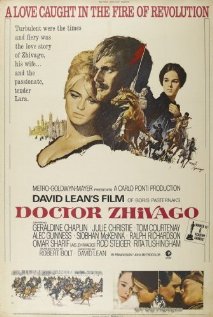
| Director(s) | David Lean |
| Producer(s) | Carlo Ponti, Arvid Griffen |
| Featured Cast | Omar Sharif, Julie Christie, Geraldine Chaplin, Rod Steiger, Alec Guinness |
| Total Facts | 40 |
David Lean cast Julie Christie as Lara after seeing her in Billy Liar (which also featured Tom Courtenay), and on the recommendation of John Ford, who had directed her in Young Cassidy.
David Lean wanted Audrey Hepburn to play Tonya, but was so impressed by Geraldine Chaplin's audition that he cast her on the spot.
David Lean's first choice for the title role was Peter O'Toole who declined, citing the grueling experience of having made Lawrence of Arabia with Lean. This created a rift between the two that was never fully healed. Dirk Bogarde and Max von Sydow were considered for the title role but was never actually offered the part before Lean offered the role to Omar Sharif.
Ingrid Pitt appears throughout this film in five different uncredited bit roles.
Rita Tushingham filmed her part in two weeks.
Rod Steiger was on set filming for 12 months.
Alec Guinness and David Lean quarreled frequently on the set of this film. According to Guinness, Lean was "acting the part of a super-star director" and frequently insulted Guinness's performance and him personally. This caused a rift to develop between the two and they would not work again until A Passage to India almost twenty years later.
William Hartnell and T.P. McKenna were both offered parts.
Carlo Ponti wanted to shoot the film in the Soviet Union, but the government refused his requests. David Lean visited Yugoslavia and the Scandinavian countries in search of locations. Both areas were too cold and the bureaucracy in Yugoslavia was too prohibitive. In the end, the majority of the film was shot in Spain.
Omar Sharif asked David Lean to consider him for the role of Pavel Antipov (Pasha) and was surprised when Lean instead offered him the title role.
Yvette Mimieux and Jane Fonda were rejected for the part of Lara.
A ten-acre replica of Moscow was built in Canillas, a suburb of Madrid. It included a cobbled 800-yard street with trolley cars, a train viaduct, a replica of the Kremlin and 60 shops and houses circling a giant plaza.
According to Freddie Young, before he reluctantly agreed to take the director of photography job following an exhausting collaboration on Lawrence of Arabia, David Lean had a major falling-out with the previous director of photography, Nicolas Roeg, over creative differences. After Young took over, an additional two weeks of photography was required to re-shoot the scenes that Roeg had shot.
After a month went by with Marlon Brando failing to respond to David Lean's written inquiry into whether he wanted to play Viktor Komarovsky, he offered the part to James Mason, who accepted. Lean, who had wanted to cast Brando as Lawrence of Arabia and offered him roles in Ryan's Daughter and his unmade "Nostromo", decided on Mason as he did not want an actor to overpower the character of Yuri Zhivago. Mason eventually dropped out and Rod Steiger accepted the role. Steiger eventually would be involved in the filming of "Dr. Zhivago" for the better part of a year, which may have been a reason that both Brando and Mason shunned the role.
Although this was a large epic on the scale of David Lean's previous film Lawrence of Arabia, it was not shot in Super Panavision or other large film format. It was shot in standard 35mm Panavision anamorphic. The 70mm prints were blow-ups from the 35mm negative.
Among its highly diverse international cast, this film contains almost zero Russian actors or even actors of Russian heritage.
Hungarian actress, Lili Muráti, was seriously injured in the scene where she runs along side of the train and grabs Zhivago's (Omar Sharif) hand to be hauled aboard. But a miscalculation was made. Sharif had been instructed to grab and hold on to Murati's hand. "She started panicking", said Ernest Day, who was watching it all through the camera, "but he didn't understand her. She was trying to make him let go, and when she did finally wrench her hand away she stumbled and disappeared out of the viewfinder". Murati had bunched up as she had fallen so the train wheels had not severed her limbs. She was also wearing thick clothes, which protected her further. Her stumble can be clearly seen in the finished film.
In an interview years after making the film, Rod Steiger said he was almost the only American among so many great British actors. "All I wanted to do was not embarrass myself."
In the scene where Julie Christie slaps Rod Steiger, Steiger slaps her back. Steiger slapping her back was not in the script or discussed during filming, Steiger did it only during filming and the stunned reaction of Christie was genuine. When Rod Steiger kisses Julie Christie for the first time, her struggling and surprise is genuine because Steiger deliberately French kissed her, sticking his tongue into her mouth.
Most of the exteriors were completely built inside as well to serve as interiors.
Over 4000 daffodils were imported from the Netherlands and placed on the outskirts of the mountain town of Soria, where Zhivago's father-in-law's country estate was located.
Producer Carlo Ponti originally bought the rights to the novel so that he could cast his wife, Sophia Loren, in the role of Lara. David Lean, however, did not want to use Loren, claiming that she was 'too tall' for the role.
Ranked #7 in AFI's 100 Years... 100 Passions: America's Greatest Love Stories, #39 in AFI's 100 Years... 100 Movies: America's Greatest Movies and received a nomination for AFI's 100 Years of Film Scores.
Screenwriter Robert Bolt recommended Albert Finney for the role of Pasha, and wrote Finney a long letter to convince him to accept. David Lean , however, refused, largely because Finney had turned down the title role in Lawrence of Arabia.
Several producers and studios bid for the rights to the novel, which Carlo Ponti won in 1963. He wanted the film to be as grand as
Lawrence of Arabia, so he recruited the crew of that film, including director David Lean, screenwriter Robert Bolt, cinematographer Freddie Young, production designer John Box and composer Maurice Jarre.
Strelnikov's armored train was a very accurate replica of actual trains that were used during WWI and WWII to patrol areas with heavy snow that were unaccessable to trucks or tanks.
The actor who plays the young Yuri Zhivago at his mother's funeral is Omar Sharif's son Tarek Sharif.
The film was not shown in Russia until 1994.
The film was shot in Spain during the regime of Gen. Francisco Franco. While the scene with the crowd chanting the Marxist theme was being filmed (at 3:00 in the morning), police showed up at the set thinking that a real revolution was taking place and insisted on staying until the scene was finished. Apparently, people who lived near where filming was taking place had awoken to the sound of revolutionary singing and had mistakenly believed that Franco had been overthrown. As the extras sang the revolutionary Internationale for a protest scene, the secret police surveyed the crowd, making many of the extras pretend that they didn't know the words.
The film was torn apart by critics when first released. Newsweek, in particular, made comments about "hack-job sets" and "pallid photography." David Lean was so deeply affected by these criticisms (despite the popularity of the film with the general public) that he swore he would never make another film.
The inside of the ice palace was mostly made up specifically formed wax.
The lady that Zhivago tries to get onto the train after grabbing her baby actually fell under it and was injured. That shot was also used in the film, though we only see her fall down.
The limousine seen at the hydro-electric power plant at the beginning and end of the film is a Czech built Tatra. These cars were favorites of Soviet bureaucrats in the late 1940s and 1950s.
The shooting exceeded the ten month schedule because of David Lean's wish to capture the different seasons during which the story took place. Filming took place during one of the mildest winters in Spain, leading to delays and the need to simulate snow with marble dust and plastic snow in the height of summer. The actors had to have their faces dabbed by make-up artists every few minutes because of their sweating.
The soundtrack sold more than 600,000 copies during the film's initial release.
This film grossed more than every other film David Lean had directed put together.
Thousands of extras were used, including Spanish soldiers and villagers, and Finnish Laplanders (for the scenes in Siberia when Zhivago deserts the Red Army).
Varykino is actually a city to the West of Moscow, not East as the movie portrays in Siberia.
When David Lean told the studio that he wanted Maurice Jarre to provide the score, he was told, "Maurice is very good on sand, but I'm sure we have someone better on snow." Jarre, of course, won the Oscar for best original score for this film.
When asked if he thought Sarah Miles would make a good choice for the part of Lara, screenwriter Robert Bolt said "No, she's just a north country slut". Bolt would later marry Miles.