Camelot (1967) Facts
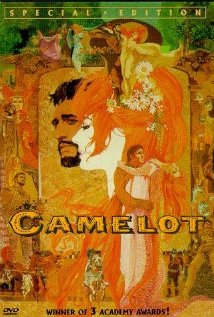
| Director(s) | Joshua Logan |
| Producer(s) | Jack L. Warner, Joel Freeman (uncredited) |
| Featured Cast | Richard Harris, Vanessa Redgrave, David Hemmings, Lionel Jeffries, Estelle Winwood |
| Total Facts | 31 |
"Camelot" was adapted from a Broadway musical that opened at the Majestic Theater in New York on Dec. 3, 1960 and ran for 873 performances. Richard Burton, Julie Andrews and Robert Goulet were in the original cast.
Marianne Faithfull was suggested by her agent for a role.
Richard Burton won the 1961 Tony Award (New York City) for Actor in a Musical for "Camelot" and his only Tony win for his role as King Arthur.
Richard Burton, who had played the role of King Arthur on Broadway in the original 1960 production, was offered the role in the film. Burton had had a huge success with Lerner & Lowe's show, winning a 1961 Tony Award for Best Actor in a Musical, but he turned the film down. Burton subsequently played King Arthur in the 1980's Broadway revival of "Camelot".
Simon Oates, Michael Latimer, Robert Morris and Nicholas Pennell were interviewed for various knights.
Lionel Jeffries was only forty when he played the elderly King Pellinore.
Richard Harris desperately sought the lead role, despite being repeatedly refused due to his limited singing ability. At one point he even paid a man to carry a board down the Strand that said, "Harris Better than Burton, Only Harris for Camelot".
Richard Harris disliked having to wear a wig and heavy eye shadow as King Arthur. He also annoyed producer Jack L. Warner by insisting on singing the musical numbers live rather than miming.
Richard Harris, a three pack a day smoker, lost his voice several times during filming.
Julie Andrews was asked to reprise her stage role of Guenevere, but had become such a popular film star by this time that she was unable to accept the role. Ironically, Jack L. Warner, who produced the movie version of Camelot, was the same man who produced the film version of My Fair Lady, and who had given the role of Eliza Dolittle to Audrey Hepburn because he thought that Julie Andrews would not be a big enough box-office name.
David Burke screen tested for Sir Dinedan.
Hugh Griffith was asked to play King Pellinore.
Dyson Lovell screen tested for Sir Sagamore.
Alan Jay Lerner used the film screenplay, rather than his original stage version, as the basis for the 1980's Broadway revival of "Camelot".
Franco Nero was cast because he had the right look to play Lancelot.
Basil Hoskins was interviewed for both Sir Paul and Sir Mellion.
Raymond Bussières and Maurice Sarfati were possibles for Dap.
Barry Justice screen tested for Mordred.
David Andrews was offered a key role but was not free.
David Saire also screen tested for this film.
James Beckett interviewed for Mordred.
Jan Waters interviewed for Guenevere.
Reg Whitehead was very seriously considered For Sir Paul.
In addition to actual Medieval castles in Spain used in this film, a castle was built on the back lot of Warner Brothers Studios for closer shots and direct storyline action. Long known at the studio as the "Camelot Castle" after filming ended, it was used in other films. In 1972, the Camelot Castle was renovated into a Tibetan Lamasery for the musical remake of Lost Horizon, and it was used extensively in the TV series Kung Fu. In the 1980's, the back lot castle was torn down to make room for an office building. Fortunately, the Alcazar de Segovia and the Coca Castle remain in Spain where they are both popular tourist attractions.
In later years, Richard Harris would buy the rights to the stage version of "Camelot" for $1 million, revamped the musical and took it on tour. This made him a very rich man.
In the original musical, Merlin is lured away from Camelot by the spirit of Nimue, who sings the song "Follow Me." Nimue was dropped from the film, and the song is sung by a chorus during the last of the scenes with Merlin.
Mordred has a song in the original musical called "The Seven Deadly virtues" that was eliminated from this film version.
Queen Guenevere's wedding dress was made of natural materials. The dress was made from fishing nets, the bodice had little seashells sewn on and on the train were hundreds of hand-sewn pumpkin seeds.
The knights' armor in the film was brought to Hollywood from Spain, where it had been used in El Cid. It was later rented to the Disney studio for Bedknobs and Broomsticks.
The song "If Ever I Would Leave You" won a Golden Globe Award for Best Original Song Written for a Motion Picture, even though it was not written especially for the film but for the original stage production of "Camelot", and all the other nominees were songs especially written for films. In addition Frederick Loewe won a Golden Globe for "Best Original Score", a score that he had actually written for the Broadway stage, not for films. This is the only instance in the history of the Golden Globe Awards that this has happened.
Two separate Medieval castles in Segovia, Spain, were used in this motion picture; one as Sir Lancelot's Castle in France and the other as Camelot itself in various long shots. The Alcazar de Segovia, with its mansard roofs and numerous turrets reminiscent of Disneyland's Sleeping Beauty's castle, was depicted as Sir Lancelot's home in Gaul (France)in this film. The opening and closing scenes were also filmed on the grounds of this same castle which may be seen in the background in the light of the approaching dawn. For Camelot itself, the Coca Castle, also in Segovia, was used in long shots and background shots to depict the towers and battlements of Arthur's legendary kingdom.