Facts > Films > Bride of Frankenstein
Bride of Frankenstein (1935) Facts
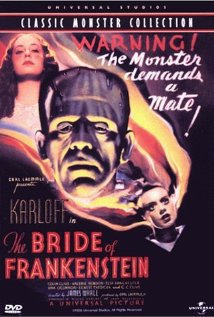
| Director(s) | James Whale |
| Producer(s) | Carl Laemmle Jr. |
| Featured Cast | Boris Karloff, Colin Clive, Valerie Hobson, Ernest Thesiger, Elsa Lanchester |
| Total Facts | 37 |
"The Bride", the most obscure of Universal Studios' Classic Monsters, is on screen for less than five minutes and is the only "Classic Monster" never to have killed anyone.
Valerie Hobson, who plays Dr. Frankenstein's fiancé/bride in the film, was only 17 years old when she appeared in the film (Colin Clive, who portrayed Dr. Frankenstein, was 35.)
Boris Karloff protested against the decision to make The Monster speak, but was overruled. Since he was required to speak in this film, Karloff was not able to remove his partial bridgework as he had done to help give the Monster his sunken cheek appearance in the first film. That's why The Monster appears fuller of face in the sequel.
Boris Karloff sweated off 20 pounds laboring in the hot costume and makeup.
Elsa Lanchester never receives on screen credit as "The Bride". The character is listed as being played by "?".
Elsa Lanchester said that her spitting, hissing performance was inspired by the swans in Regent's Park, London. "They're really very nasty creatures," she said.
Elsa Lanchester was not the only person to have a dual role in this film. In addition to her role as Minnie, Una O'Connor also appeared in the prologue, as Shelley's maid who is holding the leash as the dogs go off screen.
Elsa Lanchester was only 5'4" but for the role was placed on stilts that made her 7' tall. The bandages were placed so tightly on her that she was unable to move and had to be carried about the studio and fed through a straw.
Elsa Lanchester's shock hairdo was held in place by a wired horsehair cage.
Claude Rains was offered the role of Dr. Pretorius but he was unavailable due to filming Mystery of Edwin Drood.
Marilyn Harris, who played Maria, the girl The Monster accidentally kills in the original Frankenstein, appears uncredited as another young girl.
2007: The movie's line "We belong dead" was voted as the #63 of "The 100 Greatest Movie Lines" by Premiere magazine.
As a result of audience reactions from the film's preview screenings during the first week of April 1935, the film was extensively re-edited. Many scenes were deleted and trimmed, and at least one, the scene where the Monster stumbles into the Gypsy Camp, was added in. As a result of the editing, the original uncut film was approx. 15 minutes longer than its official release length of 75 minutes.
Director James Whale originally did not want to do a sequel to Frankenstein. For a time, Universal considered producing a sequel without Whale's involvement. One possible story included an educated monster continuing Henry's research, while another chronicled Henry's creation of a death ray on the eve of a world war. However, after 4 years of badgering by Universal, Whale agreed to do the film.
Director James Whale was once derided by a disgusted audience member for laughing during a screening.
Doctor Pretorious' full name is "Septimus Pretorious"; this is actually Latin and means "royal seven", a reference to the seven deadly sins - as well as an indicator of his true nature.
Due to his overwhelming fame as a "thriller" actor, Boris Karloff was billed simply as "Karloff" - no first name needed.
During the "bottle" sequence in Dr. Pretorius' apartment, the Doctor, while showing Dr. Frankenstein the miniature "devil" character, makes a wry comment that he sees a "certain resemblance" between him and his tiny creation. In fact, the miniature devil in the bottle was played by Peter Shaw, who was actually actor Ernest Thesiger's stand-in/film double in the picture.
Editing after previews resulted in the loss of a subplot in which Karl imitates the Monster's murderous modus operandi to eliminate his miserly aunt and uncle and direct the blame away from himself.
In the opening and closing credits the cast list says "The Monster's Mate" followed by a question mark.
It is considered inaccurate to refer to the Monster by the name "Frankenstein" rather than "Frankenstein's Monster", however in the prologue, Lord Byron actually does attach the name Frankenstein to the monster.
Not long before filming began, Colin Clive broke a leg in a horse riding accident. Consequently, most of Dr. Frankenstein's scenes were shot with him sitting.
One of James Whale's criteria for taking up the director's reins on the film was that he would have complete artistic freedom. This was easily achieved, as Universal's studio head Carl Laemmle Jr. was vacationing in Europe at the time.
One of the cast cut from the film after the preview was Helen Parrish, who played a "Communion Girl."
Part of the SON OF SHOCK package of 21 titles released to television in 1958, which followed the original SHOCK THEATER release of 52 features one year earlier.
Production of this sequel to the original Frankenstein was publicized as early as 1933 by both Universal Studio press releases and the trade paper "Daily Variety", but director James Whale did not begin work on it until late 1934. With a budget under $300,000, it was originally entitled "The Return of Frankenstein".
Shot in 46 days at a cost of approximately $400,000.
The "body count" in the original cut was 21. This was trimmed to 10 after pressure from the censors.
The musical soundtrack for this film proved so popular, it was used again in the Flash Gordon and Buck Rogers serials starring Buster Crabbe.
The original trailer promises "a lifetime of entertainment in two hours". The final edit ran 75 minutes.
The role of the monster's mate was originally offered to Brigitte Helm but she had recently married and refused to leave Germany. Louise Brooks was another actress considered by James Whale for the role.
The scene in which the monster encounters the Gypsy camp was filmed shortly before the scheduled release date as a substitute for a scene that had been edited out after sneak previews because of censorship concerns. Since the scene was filmed long after the completion of principal filming - and after the film's musical score had been completed - the Gypsy camp scene is the only segment of the movie that has no musical score.
The tiny mermaid in Dr. Pretorius' bottle was Josephine McKim, a member of the 1924 and 1928 U.S. Women's Olympic Swim Teams and one of the four members of that team to win the 1928 gold medal in the 400-Meter Freestyle Relay. McKim was also Maureen O'Sullivan's body double in the infamous nude swimming scene of the previous year's Tarzan and His Mate.
There was an epilogue to this movie featuring Elsa Lanchester as Mary Shelley, but it was cut from the final film.
Though virtually all of Billy Barty's scenes (as the little baby in the bottle) were deleted, he can still be briefly glimpsed in a wide shot of all the bottles on Dr. Pretorius's table (as well as in still photographs).
When filming the scene where the monster emerges from the burnt windmill, Boris Karloff slipped and fell into the water-filled well. Upon being helped out, he realized he had broken a leg in the fall. The metal struts used to stiffen his legs (for the famous "monster lurch") helped keep the bones in place until they could be properly set.
When the castle is self-destructing, the Doctor can be seen against the far wall. Yet he is next seen outside in the arms of his beloved, watching the explosions. There were two endings originally: the first had Doctor Frankenstein dying within the castle and this was filmed. But the producers judged this a bit harsh and wanted a happy ending, so they shot the extra footage (too expensive to re-film the explosions).