Becket (1964) Facts
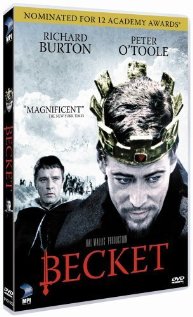
| Director(s) | Peter Glenville |
| Producer(s) | Hal B. Wallis, Joseph H. Hazen (uncredited) |
| Featured Cast | Richard Burton, Peter O'Toole, John Gielgud, Paolo Stoppa, Donald Wolfit |
| Total Facts | 32 |
John Gielgud received an Oscar nomination for appearing in just two scenes.
Richard Burton claimed to have been offered either of the main roles. However, according to the producers this was not true, since Peter O'Toole had already been cast as Henry II and Becket had to be the older man. Burton was seven years older than O'Toole.
Richard Burton initially turned the film down because he felt the idea of him playing a saint would cause the press to have a field day. He also said he would be more suited to playing Henry II.
Hal B. Wallis was not at all happy with Peter Glenville's choice of composer for the film as he'd never heard of Laurence Rosenthal. However, Glenville was adamant, having worked with Rosenthal on the stage version of the play.
Alec Guinness turned down the role of King Louis, because he "didn't believe in Becket as a film".
Peter O'Toole played the same character, Henry II, four years later in 1968's The Lion in Winter. He received Oscar nominations for both films.
Peter O'Toole's crown was made of cardboard.
Siân Phillips who plays Gwendolen was Peter O'Toole's wife at the time of filming.
A point not mentioned in the play is that Queen Eleanor's first marriage had been with King Louis VII of France; the marriage was later dissolved for reasons of common ancestry, although Henry was exactly as close a relation as Louis had been.
As a practical joke, Peter O'Toole had Richard Burton's then wife Elizabeth Taylor take the place of a nude actress lying under a blanket in order to surprise her husband. Burton was not amused.
Becket's tomb became a popular destination for pilgrimages for centuries, but it was looted and destroyed in the early 16th century in the Dissolution of the Monasteries during Henry VIII's reign, as part of the Church of England's break from Rome. A shrine was later created at the site.
Both Peter O'Toole and Richard Burton were on their best behavior during filming as they were in company of Donald Wolfit and John Gielgud, respectively O'Toole and Burton's acting mentors.
Composer Laurence Rosenthal got a hard time from producer Hal B. Wallis who insisted on a more upbeat score. Rosenthal held his ground - and was rewarded with an Oscar nomination.
Empress Matilda (Maud), King Henry's mother, had been chosen by her father King Henry I to rule after his death; but the ruling Council of England decided it would be inappropriate for a woman to rule, and named her cousin Stephen as king. This set off decades of war, during which Matilda captured much of western England and was proclaimed Lady of England. Though she never became queen, she successfully established her son Henry's claim to the throne. She died in 1167, three years before Becket's murder.
Final film of Frank Pettingell.
Final film of Sir Christopher Rhodes.
It is often alleged by various who's who's of the cinema that Ronald Lacey has a role in this film but he is nowhere to be seen.
King Henry actually was very close with his son Henry, choosing to have him raised in his close friend Becket's home - a common practice for royalty in that era. The prince's resentment over his father's possible causation of Becket's death (intentional or not) was a major reason he became distanced from his father in later years, although the prince eventually died six years before his father.
Most of the film was shot in sequence.
One of the main musical themes in the film is an adaptation of a Welsh folk tune, which Siân Phillips taught composer Laurence Rosenthal.
Originally produced on Broadway in 1959 with Laurence Olivier as Becket and Anthony Quinn as King Henry. When Quinn left the play to make films, Olivier took over the role of Henry and Arthur Kennedy was brought in to play Becket.
Queen Eleanor was in actuality perhaps the wealthiest and most powerful woman in Europe, and hardly the figure portrayed in the play. Although here she remarks that she will complain to her uncle the emperor, she was not related to Frederick Barbarossa. Complaining to Frederick would have been awkward for a devout Catholic anyway, as he had himself been excommunicated in 1160 and was in a power struggle with the pope, establishing several rival antipopes before reconciling with Rome in 1177. Eleanor also says she will protest to her father, but her father died when Eleanor was 15, long before she met Henry.
Shot over a period of 12 weeks.
The closeness between King Henry and Becket is depicted as being a purely platonic one. Homosexuality was illegal at the time in Britain and any suggestion of that would have fallen foul of the censor.
The first film of Peter Jeffrey.
The original Broadway play on which this filmed production is based opened at the St. James Theater in New York on October 5, 1960 and ran for 193 performances. Its script "Becket" by Jean Anouilh (as the basis for the screenplay) won the 1961 Tony Award (New York City) for Best Play.
The play - and indeed the film - are riddled with factual inaccuracies as Jean Anouilh did practically no research once he learned the gist of the real story.
The plot device of Lord Gilbert having murdered a priest is added to the film. In the play, Becket comes into conflict with the King for different, and more historically accurate reasons.
This film met with the approbation of Jean Anouilh who - up till that point - hadn't been very impressed with adaptations of his work.
When the film premiered, director Peter Glenville was aghast to discover that producer Hal B. Wallis had inserted an interval halfway through the film.
When the play was due to open on the West End in London, Peter O'Toole was cast as Henry II. He had to break his contract however as he had just landed the lead in Lawrence of Arabia.
While it won a screenplay award, this film still holds jointly a record for the most Oscar category losses - 10. The other joint holders with 10 category losses are The turning Point, The Colour Purple, Gangs of New York, and True Grit.