Facts > Films > Around the World in Eighty Days
Around the World in Eighty Days (1956) Facts
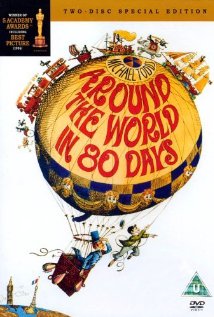
| Director(s) | Michael Anderson |
| Producer(s) | Kevin McClory (uncredited), William Cameron Menzies, Michael Todd |
| Featured Cast | Finlay Currie, Robert Morley, Ronald Squire, Basil Sydney, John Gielgud |
| Total Facts | 58 |
Gregory Peck was originally cast as the U.S. Cavalry officer, but producer Michael Todd felt Peck wasn't taking the role seriously enough and fired him, recasting the role with Tim McCoy.
Marlene Dietrich's gown reportedly cost $300,000.
Ronald Colman came out of a 5 year retirement to do his cameo.
Fernandel was initially stunned at being offered such a tiny part. Michael Todd's prowess at persuasion soon won him over.
Orson Welles was a little upset he did not get a cameo in the film. He was upset because before Michael Todd produced this film, he produced a stage version by Welles. The play flopped but Todd turned the project into a film anyway and it enjoyed great success. Welles felt he gave the idea to Todd in the first place.
John Wayne was considered for the role of the cavalry officer, but he turned it down.
Maurice Chevalier was invited to do a cameo but asked in return to be billed at the foot of the cast-list. Michael Todd said "no" so Chevalier declined the offer.
Alexander Korda had previously taken an unsuccessful stab at the material. His advice to Michael Todd was "Back away from it, Mike. I've been trying to lick it for years. Total loss."
Shirley MacLaine to this day contends that she was miscast in this, her third film.
Shirley MacLaine wrote that filming a scene with thousands of extras ground to a complete halt because the propman forgot to put the bottle of champagne in the balloon with David Niven and Cantinflas.
John Farrow directed a week or so of the Spanish scenes.
David Niven always professed that Phileas Fogg was his favorite role.
Imanos Williams, a real Japanese circus performer, appears in the scene where Cantinflas joins up with a Japanese circus as a performer.
Michael Todd never had anyone else other than David Niven in mind for the role of Phileas Fogg.
Michael Todd's original estimate for the film's budget was $3 million. The film ended up costing nearly double that, largely thanks to Todd's demands for verisimilitude and location shooting.
Noel Coward was the first star in England to sign for the project.
Victor Young's fabulous Oscar winning music score was recorded in July, 1956 at the former Charlie Chaplin Studio on La Brea Avenue in Hollywood. At the time, Charles Chaplin had sold it to an independent outfit that had renamed it Kling Studios. Michael Todd was leasing space there during production. A sound stage normally used for filming was specially converted into a music scoring stage. Six Neumann U-47 condenser microphones were placed over the orchestra which were all fed to a 35mm magnetic six-track recorder. The entire set up was only used once for this film and was later torn down and the stage reverted back to filming.
68,894 extras from 13 different countries worked on this film. This is one of the largest number of extras to ever appear in a single picture. The 1,243 extras listed on the IMDb page (and also in the original program book) were only the extras who worked on the film in Hollywood, California alone.
According to Farley Granger in his autobiography "Include Me Out," Mike Todd, while shooting on location in Venice, filmed him as a gondolier on the Grand Canal, a cameo that was never used in the film.
According to David Niven's agent, producer Michael Todd originally wanted Cary Grant for the role of Phileas Fogg, but had given up after trying for 6 months.
After winning the Oscar, Michael Todd hired out Madison Square Garden and threw a huge party. 18,000 guests attended, with the celebration frequently threatening to degenerate into all-out chaos. Todd himself called the party a disaster.
Although it wasn't nominated for Best Original Song, the theme tune "Around the World" by Victor Young and Harold Adamson became a huge international hit for Bing Crosby.
Contrary to popular belief, production reports show that the large majority of this film was shot in Hollywood. An extensive number of exterior second unit locations were used, but most of the scenes were actually shot on sound stages in Hollywood, and on the back lots of over seven major studios including RKO-Pathe, RKO, Universal-International, Warner Bros., Columbia and 20th Century-Fox.
For the Spanish-dubbed version of the film, Cantinflas himself provided the voice of his character Passepartout.
In order to make the film really stand out from the crowd of epic films, producer Michael Todd implored theater owners to promote the film "exactly as you would a Broadway show": organize reserved seats, pass out playbills before the movie, remove clocks from the theater and ban the sale of popcorn.
In the original novel, Princess Aouda's Eastern garb is taken off her when she is rescued by Phileas Fogg and Passepartout from the sacrifice. She is then dressed by them in European garb, specifically: a dress, a magnificent Otterskin jacket, and a large cloak. She wears this garb for the rest of the journey around the world and the trip back to England.
Is generally considered the single largest film project ever undertaken in Hollywood. Filming was completed in 75 shooting days.
One of the many coups that Michael Todd pulled off was to get permission to shoot a rocket launch which can be seen at the start of the film. Todd directed this sequence himself.
Only about two or three process (visual effects) shots appear in the entire film, early on when David Niven and Cantinflas are in the balloon and we see them looking out over the Pyrenees. These shots were accomplished by animation cameraman William Williams, who also worked on the process shots for Alfred Hitchcock's Vertigo.
Only nine Todd AO cameras were in existence at the time of shooting, and all of them were employed in the making of this film.
Original director John Farrow was fired from the production by Michael Todd after about a week. He realized quickly that only one person could run a Michael Todd production and it wasn't going to be him. Farrow's involvement was such that he was given a screenplay credit, and ironically, won an Oscar for his troubles.
Over a dozen airline companies provided service to the actors and technicians on this film as they flew from Hollywood to the locations overseas. These included such major companies as Pan Am and TWA, as well as foreign companies such as Middle Eastern and Pakistan Air. Private pilot Paul Mantz also provided airline accommodations for producer Michael Todd.
Phileas Fogg, Passepartout, and Princess Aouda travel east across the U.S. on the locomotive Jupiter. The Jupiter was the Central Pacific Railroad's representative at the Golden Spike ceremony that created the first transcontinental railroad in 1869.
Producer Michael Todd had a reputation for being tight-fisted. Reportedly, S.J. Perelman required payment in cash before handing over pages of the script.
Some of the ship scenes were completed in the Sersen tank at 20th Century-Fox studios under the supervision of Fox visual effects supervisor Fred Sersen. The visual effects team worked on the boat props as well. The Sersen tank was used for a number of independent productions including Walt Disney's 20000 Leagues Under the Sea.
Some sources list Ava Gardner as one of the cameo performers in this film. It is unclear whether or not she may have contributed to the film with her performance being cut, or whether this is simply an error.
The barge used in Bangkok belonged to the King of Thailand, who lent it to producer Michael Todd.
The bullfighting sequence was added because Cantinflas had bullfighting experience. He actually was in the ring with the bull, eschewing the use of a stunt double. This was one of the first sequences to be shot.
The cameo role of the manservant that Phileas Fogg discharges at the beginning of the film was originally offered to Laurence Olivier, who turned it down. It was played in the film by John Gielgud.
The film began shooting with John Farrow as director, and Emmett Emerson as the first assistant director in London. Both were replaced.
The film begins in the then standard square frame format before expanding into the much wider Todd AO format. This was done solely to showcase the size of the screen.
The film features the longest closing credits sequence up to that time and for many years afterward - six minutes and twenty-one seconds. All of the film's credits are shown only at the end, and the very last credit to be shown is the film's title.
The film played for three consecutive years at the Rivoli Theatre in New York, from 1956 to 1959, in Todd AO. In 1959, it was sent out on general release in regular widescreen format.
The film that created the idea of "cameo roles" as a means of inviting established stars to participate in a production.
The film used 140 sets built at six Hollywood studios, as well as in England, Hong Kong and Japan.
- 74,685 costumes were designed, made or rented for use in the film.
- The cast and crew flew over 4,000,000 miles.
- 68,894 extras were used while shooting the film in 13 countries.
- 90 animal handlers managed the record 8,552 animals used (3,800 sheep, 2,448 buffalo, 950 donkeys, 800 horses, 512 monkeys, 17 bulls, 15 elephants, 6 skunks, and 4 ostriches).
The film utilized the talents of, at that time, the most animals ever in any film.
The film was initially released with the screenplay attributed solely to S.J. Perelman. This was later changed after James Poe and John Farrow sued.
The following famous people appear in small parts in the film, and are credited: A.E. Matthews, Alan Mowbray, Andy Devine, Basil Sydney, Beatrice Lillie, Buster Keaton, Cesar Romero, Charles Boyer, Charles Coburn, Tim McCoy, Edmund Lowe, Edward R. Murrow, Evelyn Keyes, Fernandel, Finlay Currie, Frank Sinatra, George Raft, 'Gilbert Roland', Glynis Johns, Harcourt Williams, Hermione Gingold, Jack Oakie, Joe E. Brown, John Carradine, John Mills, José Greco, <a href="sea
The last film of both Harcourt Williams and Robert Newton.
The role of Passepartout was greatly expanded from the novel to accommodate the presence of Mexican star Cantinflas. In the mid-50s, he was the wealthiest movie star in the world, and was given top billing in Latin countries.