Facts > Films > A Man for All Seasons
A Man for All Seasons (1966) Facts
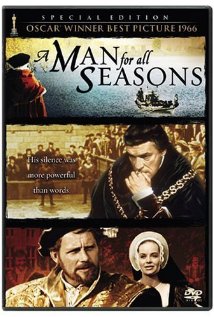
| Director(s) | Fred Zinnemann |
| Producer(s) | Fred Zinnemann, William N. Graf |
| Featured Cast | Paul Scofield, Wendy Hiller, Leo McKern, Robert Shaw, Orson Welles |
| Total Facts | 27 |
Vanessa Redgrave refused to be paid for her cameo role as Anne Boleyn.
Vanessa Redgrave was originally lined up to play Margaret but she had theater commitments. Instead, she agreed to do an unpaid cameo as Anne Boleyn on the condition that it remain unbilled.
Richard Burton turned down the role of Sir Thomas More.
Orson Welles used an exact duplicate of Cardinal Wolsey's official seal, as well as authentic sheepskin parchment and a quill pen.
Paul Scofield and Leo McKern reprised the roles they played in the Broadway production of the play. During most of the play's 20-month run, the role of Margaret was played by a young Faye Dunaway.
Paul Scofield won the 1962 Tony Award (New York City) for Actor in a Drama for "A Man for All Seasons" and recreated his role in the filmed production.
Charlton Heston lobbied heavily for the role of Thomas More, but was never seriously considered by the producers as a candidate for the role. Heston would go on to play More in several stage productions of the play and ultimately film a television production of it in 1988.
Richard Harris was considered for the part of the king.
Nigel Davenport was offered his role when John Huston turned it down.
Robert Bolt borrowed the title from Robert Whittinton, a contemporary of Thomas More, who in 1520 wrote of him: "More is a man of an angel's wit and singular learning; I know not his fellow. For where is the man of that gentleness, lowliness and affability? And, as time requireth, a man of marvelous mirth and pastimes, and sometime of as sad gravity: a man for all seasons."
Robert Bolt offered the part of Norfolk to his friend, American actor-director John Huston. Huston turned it down.
Dilys Watling auditioned for a featured role.
Eira Heath considered turning her part down because it was so tiny.
Nicholas Grimshaw was offered a featured role but confusion over the offer meant he accepted a stage role instead.
Norman Scace was offered a featured role but was not free because the dates clashed with a play.
According to Welles, he had Zinnemann removed from the set and directed his scenes himself.
Although it is never mentioned in the film Lady Alice More was not Margaret More's mother. Before Alice Sir Thomas More was married to a woman named Jane Colt with whom he had four children. She died giving birth to Margaret. More remarried almost immediately with Alice, who was a widow herself. They did not have any children, but she raised Margaret as her own.
Filmed over a period of 12 weeks.
Five of the historical persons depicted in the film all had the first name Thomas: Sir Thomas More, Thomas Cardinal Wolsey, Thomas Cromwell, Archbishop Thomas Cranmer, and Thomas Howard (the Duke of Norfolk). Perhaps to avoid confusion, in the play and film, the only character referred to as Thomas is Thomas More.
For his first major film role, John Hurt was paid £3,000.
In the first (London) run of the play, Leo McKern played not Cromwell but the Common Man, a narrator-figure who addresses the audience and plays several characters in the story - More's servant Matthew, the man who rows him home, his jailer, etc. These characters also appear in the film, but are played by several actors. The original stage device of having them all played by the same actor was kept in the 1988 version. In the play, the lines stating what happened to the historical figures after More's death are spoken by the 'Common Man'; in the film, they are spoken in voice-over at the end by Colin Blakely, who plays Matthew.
One of only 4 productions to win both the Best Play Tony (1962) and the Best Picture Oscar (1966). The other 3 are My Fair Lady (1957/1964), The Sound of Music (1960/1965) and Amadeus (1981/1984).
The original play opened at the ANTA Playhouse (New York) on November 21, 1961 and played for 637 performances starring Paul Scofield.
The producers originally wanted Laurence Olivier as Thomas More and Alec Guinness as Wolsey, but director Fred Zinnemann insisted on Paul Scofield and Orson Welles in the roles.
The trial and execution scenes are based very closely on an eyewitness account, published anonymously in the Paris Newsletter of August 4, 1535.
To keep the budget under $2 million, all the actors took salary cuts. The only actors to receive payments over £10,000 were Orson Welles, Paul Scofield and Susannah York.
Truckloads of Styrofoam were ordered to simulate a snowy landscape. As soon as it was delivered, real snow began falling.